

Gen Z is obsessed with Japan because decades of cultural exports built genuine familiarity before most of them ever booked a flight.
Pokémon, Nintendo, Studio Ghibli, ramen, and Uniqlo became part of daily life across the US, UK, Australia, and Europe long before TikTok existed. By the time social media turned Japan into a visual shorthand for beauty and order, the emotional groundwork was already there.
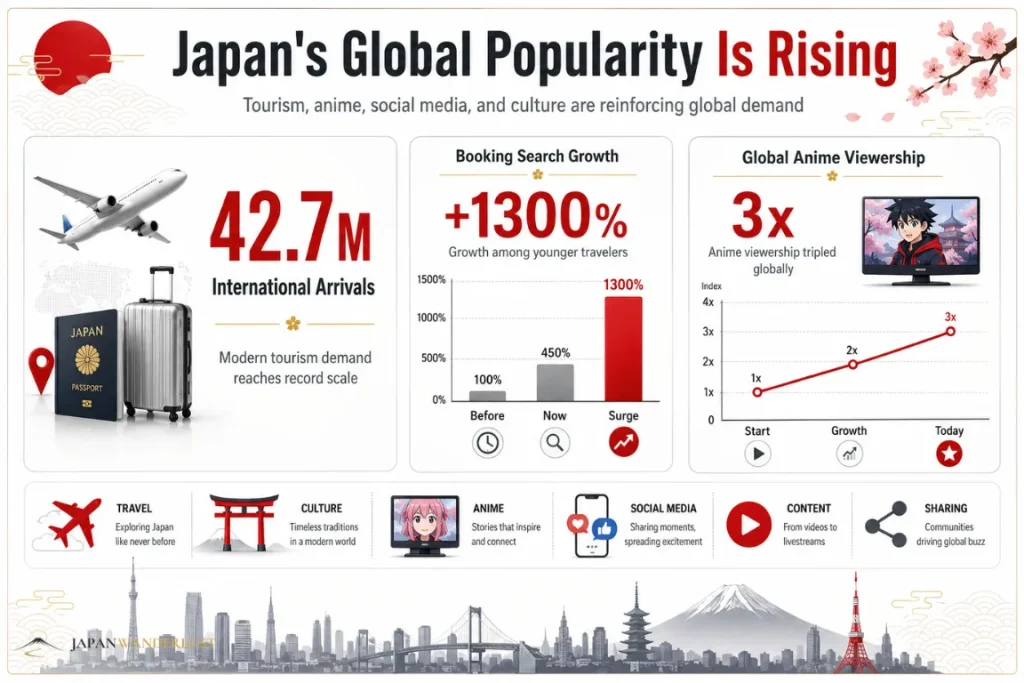
- Japan recorded 42.7 million international arrivals in 2025.
- Booking searches among travelers under 30 surged over 1,300% in the same period.
- Anime viewership has tripled globally over the past five years.
The “Japan effect” on social media is easy to spot. Someone tags “Tokyo, Japan” on a video of a convenience store run, a walk through a covered shopping arcade, or a bowl of ramen at an eight-seat counter. The location does the heavy lifting.
But that aesthetic pull is the surface layer. Underneath it sits a longer story about soft power, a generation looking for something specific, and a country that spent forty years building toward exactly this moment.
This piece traces how Japan got here, why Gen Z responded the way it did, and what the obsession tells us about both.
TL;DR
Gen Z’s obsession with Japan didn’t start on TikTok it was forty years in the making. Pokémon, Nintendo, Studio Ghibli, and ramen built genuine familiarity before anyone booked a flight. Social media then handed a visually perfect country a global amplifier, a weak yen made it affordable, and a generation hungry for order, beauty, and craft found exactly what it was looking for. Japan isn’t a trend. It’s a mirror.
It Didn’t Start With TikTok: Japan’s Slow Cultural Takeover
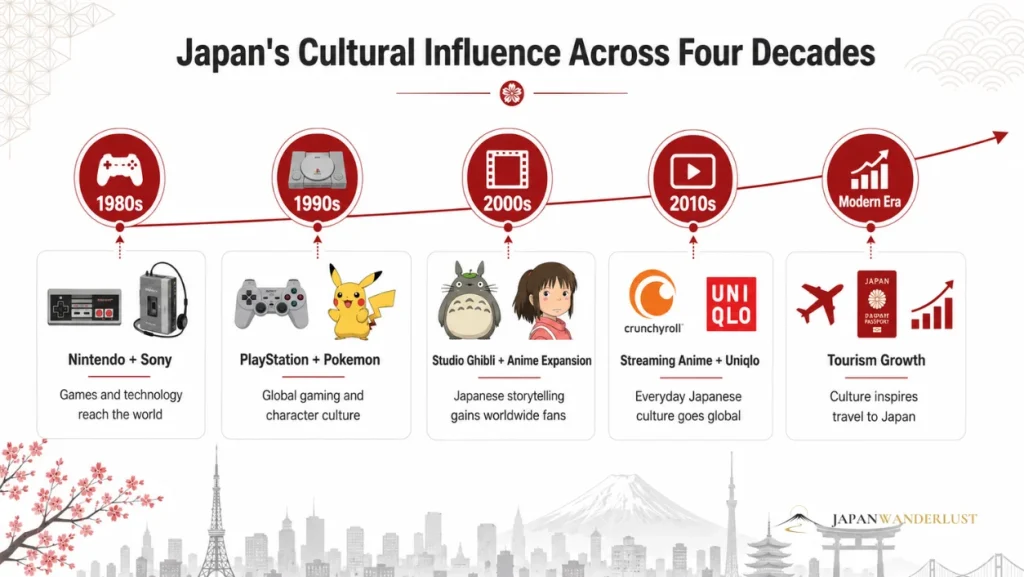
Japan’s cultural grip on the West took four decades to build. TikTok didn’t create the obsession. It just made it visible.
In the 1980s, Japan was an economic force that commanded serious Western attention. Nintendo shipped the Famicom to North America in 1985. Sony defined how the world listened to music. Toyota and Honda reshaped the car industry. American business schools sent managers to Tokyo to study Japanese manufacturing methods. The country was admired, not romanticized.
The 1990s changed the direction of that admiration. PlayStation arrived in 1994. Pokémon launched in 1996 and within three years had become the highest-grossing media franchise on earth.
Hayao Miyazaki’s Spirited Away won the Academy Award for Best Animated Feature in 2003 the first and still the only non-English-language film to win the award outright. Studio Ghibli, founded in 1985, had by then become one of the most culturally significant animation studios in the world.
Dragon Ball Z, Pokémon, and Naruto became staples of Western children’s television, normalizing anime as mainstream entertainment rather than niche import. Hello Kitty appeared on everything from pencil cases to Louis Vuitton collaborations. Sushi moved from specialty restaurants to supermarket shelves.
The Tamagotchi, Bandai’s pocket virtual pet released in 1996, captured the strange charm of Japanese product culture better than almost anything. Merry White, an anthropology professor at Boston University who specializes in Japan, recalls public swimming pools in Honolulu installing Tamagotchi babysitting stations in the late 1990s so children could swim without their virtual pets dying from neglect. “We all thought, ‘This is insane,'” she said. “But you don’t always have to be deadly serious or have proof of rationality.”
The 2010s normalized what the previous decade had introduced. Netflix and Crunchyroll gave anime a mainstream distribution system. Attack on Titan, Demon Slayer, and Jujutsu Kaisen found audiences with no prior connection to Japanese culture. Uniqlo opened stores across Europe and North America. Ramen restaurants appeared in cities that had never heard the word ten years earlier.
This is what researchers call the “Japan, not Japan” effect. Sushi lost its foreign label. Ramen became comfort food. Uniqlo sits next to Gap in shopping centers without anyone noting the origin. The imports became so embedded that their Japanese identity faded into the background.
Political scientist Joseph Nye described this process as soft power: the ability to shape preferences through attraction rather than coercion. Japan never pushed its culture outward through force or policy mandates. It built products, stories, and aesthetics that people chose to adopt. By the time Gen Z came of age, that choice had already been made for them by the generation before.
Why Does Gen Z Love Japan So Much?
Gen Z loves Japan because it sits at the intersection of everything they already consume. Anime, gaming, food, and fashion all trace back to Japan. The country doesn’t feel foreign to a generation that grew up with it.
There is no single entry point. One person arrives through Studio Ghibli films, discovers ramen, then Japanese streetwear, then city pop. Another starts with FromSoftware games and ends up researching Kyoto temples. Japan cross-references itself constantly, and each gateway leads to three more.
The emotional pull runs alongside the cultural one. Japan is safe, clean, and functional in ways that feel striking to travelers from cities where public infrastructure is visibly strained. That contrast is real, and Gen Z talks about it openly.
Japan also photographs and films exceptionally well. Convenience stores, temple gates, neon-lit alleyways, and cherry blossom-lined rivers all perform strongly on TikTok and Instagram. Sharing Japan content is rewarding, which keeps the feedback loop running.
The aesthetics are the entry point. What keeps people engaged goes considerably deeper.
The Five Gateways Gen Z Uses to Enter Japan
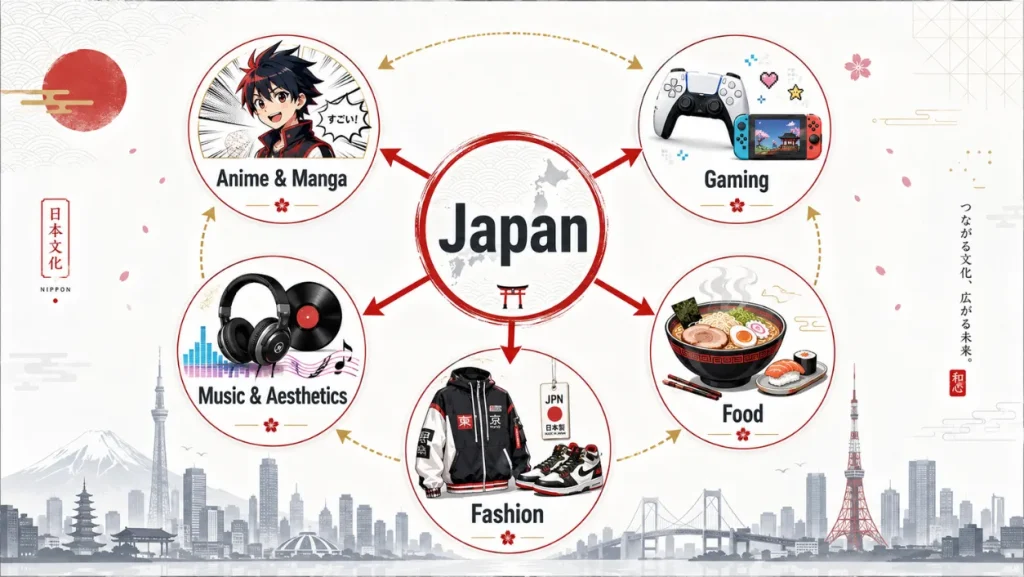
No single trend explains why Gen Z is drawn to Japan. There are five distinct entry points, and most people pass through more than one.
| Gateway | What it includes | Why it sticks |
| Anime & manga | Studio Ghibli, Attack on Titan, Demon Slayer, niche genre catalogues on Netflix and Crunchyroll | Normalised as children’s programming, now a lifelong habit with deep back catalogues |
| Gaming | Nintendo, FromSoftware (Dark Souls, Elden Ring), Square Enix (Final Fantasy) | Shaped entire childhoods; Japanese game aesthetics influenced how a generation thinks about art and design |
| Food | Sushi, ramen, matcha, konbini (convenience store) culture | $1 onigiri rice balls and 7-Eleven hot food go viral constantly; food tourism to Japan is now a category of its own |
| Fashion | Uniqlo, Japanese workwear, vintage denim, Comme des Garçons | “Buy less, buy better” production ethics align directly with Gen Z sustainability values |
| Music & aesthetics | City pop revival, lo-fi, J-pop; wabi-sabi and kawaii as visual identity | Used as shorthand for mood and identity on TikTok, YouTube, and Pinterest |
The gateways reinforce each other. Someone who is interested in anime notices Japanese fashion in the shows they watch. A gamer researching FromSoftware locations ends up reading about Kyoto architecture. A food tourist filming konbini hauls starts exploring neighborhood izakayas (casual Japanese pubs with food and drinks).
Japan is unusually good at this cross-referencing. Each entry point contains a door to several others.
The food gateway deserves particular mention. Anthony Bourdain, the late chef and travel documentarian, put it plainly: “I love Tokyo. If I had to eat only in one city for the rest of my life, Tokyo would be it.” Most serious chefs would agree. The city has held more Michelin stars than any other in the world for over fifteen years, a title built through decades of culinary discipline, not just international recognition.
Japan as the Antidote: Civility, Safety, and “Living in the Future”
Japan ranks first globally for safety from crime and on public transportation, according to Berkshire Hathaway Travel Protection’s annual index. For Gen Z travelers who grew up in cities with visible disorder, that ranking lands as more than a statistic.
Tokyo is one of the densest cities on earth. It has almost no public trash cans, yet stays consistently clean. Residents carry their rubbish home. That civic norm is so different from what most Western travelers know that it reads, on first encounter, as extraordinary.
The infrastructure reinforces the feeling. Shinkansen (bullet trains) run at 320 km/h and arrive within seconds of their scheduled time. Subway platforms are spotless. Vending machines dispense hot food, cold beer, and umbrellas on street corners at 2am without issue. Gen Z travelers describe this as “living in the future,” and the phrase appears so often in travel content that it has become its own meme.
The contrast with Western public life sharpens the impression. Delayed and dirty transit systems, rude service encounters, and visibly crumbling public spaces are common experiences for travelers from the US, UK, and Australia. Japan doesn’t just feel different. It feels like a rebuttal.
That said, the “Japan as utopia” framing is partly a projection. Real Japan carries real tensions. Economic stagnation has compressed wages for a generation. Workplace culture remains intensely demanding. Women continue to face structural barriers in employment and public life that rarely appear in travel content. The Japan that goes viral is a curated slice. The full picture is more complicated.
Why Are People So Obsessed With Japan?
Japan occupies a position no other country holds: it is hyper-modern and deeply traditional, often on the same city block. A 1,200-year-old temple sits ten minutes by train from a 68-story skyscraper. That contrast doesn’t resolve. It just keeps pulling people back.
The practical case is strong on every dimension. Japan is safe, clean, and easy to navigate even without Japanese language ability. The food system, from three-Michelin-star kaiseki (multi-course traditional dining) down to a 200-yen vending machine coffee, overdelivers at every price point. Public transport connects almost everywhere. History and contemporary culture exist in the same neighborhoods.
Every generation has found something different to admire. In the 1980s, Western business leaders flew to Tokyo to study Japanese manufacturing. In the 1990s and 2000s, pop culture took over. Now the draw is philosophical: ikigai (a sense of purpose built from daily life), wabi-sabi (finding beauty in imperfection), and kintsugi (repairing broken things with gold) have entered mainstream wellness and design language across Europe and North America.
Japan has also taken the cultural prestige position that France held for most of the 20th century. Omakase dining (chef-led tasting menus where you eat what is served) signals taste the way a Paris reservation once did. Japanese minimal home goods, denim, and knives carry the same aspirational weight as French fashion once did for a previous generation.
For Gen Z, social media has accelerated what earlier generations felt across decades. What took thirty years to build as cultural familiarity now takes three months of TikTok exposure. The obsession is the same. The speed is not.
The “Cool Japan” Strategy: This Was by Design
Japan’s global image shift was not accidental. The government ran a deliberate soft-power campaign to reposition the country from “quirky subculture export” to “refined cultural destination.”
The concept originated with American journalist Douglas McGray, who in 2002 wrote a landmark essay arguing that Japan possessed what he called a “gross national cool.” He argued that if cultural output could be measured the way GDP is, Japan would rank at or near the top. McGray’s essay effectively gave the Japanese government a framework for what it was already doing instinctively, and a rationale for doing it more deliberately.
| Element | Before (Global Perception) | After (Engineered Image) |
| Cultural exports | Anime, gaming niche | Craftsmanship, tradition, design |
| Audience | Subculture fans | Global professionals and travelers |
| Positioning | “Interesting, quirky” | Refined, premium, cultural |
| Platforms | Entertainment media | Diplomacy, food, design, tourism |
The strategy had four main levers:
- Government-led “Cool Japan” repositioning: The Ministry of Economy, Trade and Industry formally adopted Cool Japan as a diplomatic and economic framework, funding initiatives to promote Japanese design, food, fashion, and traditional crafts to global audiences. The Cool Japan Fund was established as the financial vehicle, channeling investment into companies that introduced Japanese culture abroad.
- Japan House as urban cultural diplomacy: Japan House locations in London, Los Angeles, and São Paulo target city professionals, not anime fans. The programming covers architecture, craft, cuisine, and contemporary design. The venues feel closer to a high-end cultural institute than a tourist board office.
- Michelin dominance as engineered prestige: Tokyo has held more Michelin stars than any other city in the world for over fifteen years. That didn’t happen passively. Japanese chefs, restaurant culture, and the government’s international food promotion programs built it deliberately. The stars became a global signal that Japanese food belonged at the top of the prestige hierarchy.
- The weak yen as demand accelerant: From 2023 onward, the yen dropped to its lowest level against the dollar and pound in decades. A trip to Japan that once felt expensive became, by comparison, significantly affordable. A high-end Tokyo hotel that cost $400 a night in 2019 cost closer to $260 in 2024 at the same quality level. Luxury became accessible, and booking numbers followed immediately.
The result was a country that now appeals across multiple audience segments simultaneously: the anime fan, the food traveler, the design professional, and the luxury tourist. That breadth is not an accident.
Social Media as Amplifier: The Network Effect in Real Time
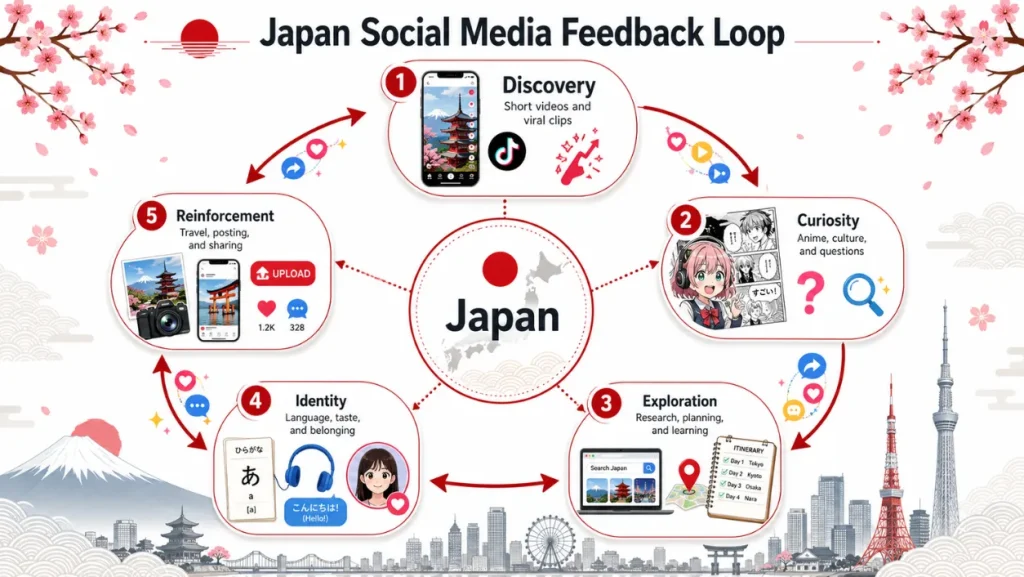
Japan didn’t just benefit from social media. It became one of the most socially amplified destinations on earth because its aesthetics, infrastructure, and subcultures are unusually well-suited to content creation.
The path from first exposure to active obsession follows a recognizable sequence:
- Discovery: A TikTok or Instagram video tagged “Tokyo, Japan” appears in the feed. The location alone lifts the aesthetic. Cherry blossoms, neon signs, or a spotless subway platform do the rest.
- Curiosity: The viewer searches for more. Anime clips, street food videos, and neighborhood walk content fill the gap. Japan rewards passive watching.
- Exploration: The content expands. Specific neighborhoods ,Shimokitazawa for vintage, Yanaka for old Tokyo streetscapes ,specific foods, specific fashion subcultures emerge. Japan has enough layers to sustain months of research.
- Identity: Engagement deepens into participation. Language learning apps see spikes in Japanese enrollments. Cosplay communities grow. Collecting (figures, vinyl, sneakers) becomes part of the identity.
- Reinforcement: The viewer travels, creates their own content, and posts it. The loop restarts for someone else watching their feed.
The content types that fuel this cycle are consistent:
- Anime pilgrimage tourism (visiting real locations from Demon Slayer, Your Name, or Spirited Away)
- Konbini vlogs (filming convenience store hauls at Lawson or FamilyMart)
- Sakura season content (cherry blossom viewing in Maruyama Park, Kyoto or along the Meguro River in Tokyo)
- Izakaya night walks (filming the covered alleyways of Shinjuku’s Golden Gai or Osaka’s Dotonbori)
There is also a philosophical alignment driving the depth of engagement. Cultural critic Mark Fisher, in his book Ghosts of My Life, argued that late-stage capitalism leaves people overstimulated and exhausted, creating a hunger for the familiar, the well-crafted, and the slow. Whether or not Gen Z has read Fisher, many describe their Japan obsession in terms that echo his diagnosis: they are drawn to a culture that values patience, craft, and restraint in a media environment that relentlessly rewards speed and noise. The social media shift toward “slow life” content ,trad-wives, homegrown vegetables, cottagecore, seasonal rituals ,runs on the same current. Japan arrived at exactly the right moment.
Japan cross-references itself inside this loop. A viewer who arrives through food content encounters Japanese fashion within weeks. A gamer researching FromSoftware aesthetics ends up watching Kyoto temple vlogs. Fandom here is not a single interest. It is a community infrastructure with Japan at the center, and social media keeps the entry points permanently open.
Japan Is the New France: Status, Taste, and Cultural Prestige
For most of the 19th and 20th centuries, French culture set the standard for Western aspiration. French food meant fine dining. French fashion meant taste. French philosophy meant intellectual seriousness. That cultural hierarchy has shifted.
| Era | Cultural Aspiration |
| 19th–20th century | France = taste, luxury, refinement |
| 21st century | Japan = taste, minimalism, cultural depth |
Japan now occupies the position France held. The signals are everywhere:
Food: Omakase dining (chef-led tasting menus) has replaced the French tasting menu as the benchmark for serious culinary experience. Matcha appears in fine patisseries, mainstream coffee chains, and home kitchens simultaneously.
Objects: Japanese knives, ceramics, and stationery carry the same weight that French cookware and linen once did. Buying Japanese means buying with intention.
Fashion: Japan spans the entire price spectrum without losing prestige. Uniqlo delivers quality basics at accessible prices. Comme des Garçons sits at the apex of global fashion. Both are respected. Few countries manage that range.
Philosophy: Ikigai (finding purpose in daily life), wabi-sabi (accepting imperfection as beauty), and kintsugi (repairing broken things with gold to honor their history) have moved from niche design concepts into mainstream Western wellness, self-help, and interior design language.
What makes Japan’s prestige position durable is that it works at every level:
- Affordable: A Uniqlo merino sweater or a 500-yen konbini lunch
- Aspirational: A ryokan (traditional Japanese inn) stay in Hakone or an omakase counter in Ginza
- Cultural: Temple architecture, textile craft, and ceramic traditions with centuries of documented history
- Exportable: Concepts, aesthetics, and products that travel well and embed themselves in other cultures without losing their origin signal
France built its cultural dominance through institutions: the Académie française, haute couture houses, Michelin. Japan built its dominance through products and stories that people chose to adopt without being told to. That difference matters. Chosen culture embeds more deeply than prescribed culture.
The Tension: Appreciation vs. Glazing
“Glazing” is internet slang for placing something on an uncritical pedestal. Applied to Japan, it means consuming the aesthetics, the safety statistics, and the convenience store content while ignoring everything that complicates the picture.
| Surface View | Reality |
| “Perfect, orderly Japan” | Economic stagnation has compressed wages for a generation |
| Anime fantasy Japan | Workplace pressures and gender inequality are structural and well-documented |
| Tourism boom as mutual win | Kyoto residents are visibly fed up with selfie crowds and tour groups |
| Cultural admiration | Uncritical obsession can flatten a complex country into a mood board |
The over-tourism numbers are real. Japan recorded 42.7 million arrivals in 2025. In Kyoto, the most photographed neighborhoods now have mesh barriers blocking famous views to deter crowds. Access to certain temple grounds has been restricted on weekends. Residents in Gion, Kyoto’s geisha district, have asked tourists to stop entering private lanes entirely. The tension between visitor demand and local life is no longer manageable through politeness alone.
The gap between “anime Japan” and lived Japan is also worth sitting with. The country that appears in travel content is largely Tokyo, Kyoto, and Osaka on clear days in cherry blossom season. Real Japan includes a shrinking rural population, an aging workforce, and a gender pay gap that ranks among the widest in the developed world. None of that cancels the genuine appeal. But it does mean the country is not the utopia the algorithm serves up.
The shift from obsession to appreciation looks like this in practice:
- Curiosity over blind admiration: Ask what life actually looks like for people who live there, not just visit
- Learn context, not just aesthetics: Understand what wabi-sabi or ikigai means within Japanese cultural history before putting it on a tote bag
- Support local creators: Follow Japanese photographers, writers, chefs, and designers, not just Western creators filming in Japan
- Travel responsibly: Stay in locally owned accommodation, eat where residents eat, and follow posted rules without waiting to be asked
The obsession is understandable. Japan earned it over decades. Respecting what it actually is, rather than what the feed shows, is what makes a visit worth taking.
Why Japan became more than a travel trend
The answer is not one thing. It never was.
Japan spent forty years exporting culture so effectively that an entire generation grew up treating its products, stories, and aesthetics as their own. Then social media handed that generation a content format perfectly suited to everything Japan does well. Then a currency collapse made the country dramatically affordable. All three arrived at the same time.
The layered reasons come down to this:
- Decades of soft power that built genuine familiarity before anyone booked a flight
- Social media amplification that turned personal discovery into a global feedback loop
- A generation actively looking for order, beauty, and meaning in public life
Every era finds something different in Japan. The 1980s found an economic model. The 1990s found pop culture. This generation has found something closer to a value system. Civility, craft, patience, and an aesthetic built on restraint rather than excess. Those are not things Gen Z is finding easily at home.
Japan isn’t a trend. It’s a mirror.
What it reflects is a picture of what this generation wants and, in most cases, cannot find where they live. That is a powerful draw. It is also, as the previous section noted, partly a projection. The real country is more complicated than the feed suggests, and more interesting for it.
The travelers who get the most from Japan are the ones who go beyond the content they have already seen. The temple that didn’t appear in their For You page. The neighborhood restaurant with no English menu and a chef who has been making one dish for thirty years. The ryokan breakfast that takes an hour because each element was prepared separately and presented with care.
That version of Japan exists. It just takes more than a TikTok algorithm to find it.
Ready to experience Japan beyond the TikTok filter? Explore our private Japan tours