

Japanese culture stands as one of the world’s most distinctive and enduring traditions, with over 70% of Japanese people actively participating in cultural ceremonies and festivals each year. This blend of ancient customs and modern innovations has created a society unlike any other.
The success of Japan’s cultural preservation is evident in places like Kyoto, where over 1,600 Buddhist temples and 400 Shinto shrines continue to draw millions of visitors annually, seamlessly integrating centuries-old practices with contemporary life. Many of these sites have maintained their original architectural features and religious ceremonies for over 1,000 years.
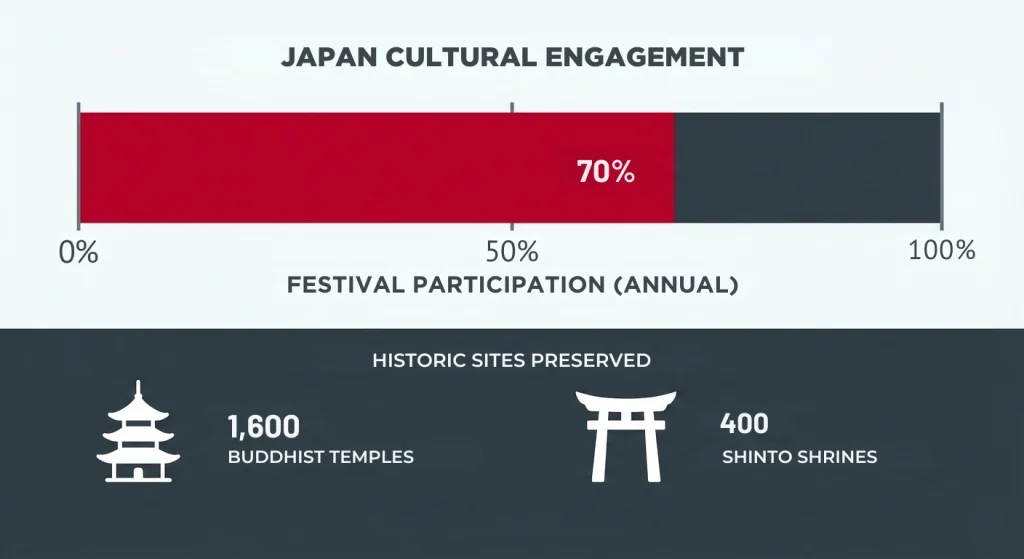
This comprehensive guide examines the evolution of Japanese culture from ancient times to the present day, covering everything from traditional arts and festivals to modern lifestyle changes. We’ll explore how religious beliefs, artistic expressions, and social customs have shaped Japan’s identity, while also looking at contemporary influences like technology and popular entertainment.
By reading this article, you’ll gain a deep understanding of Japanese cultural values, customs, and etiquette practices that will help you appreciate this fascinating culture and interact respectfully with Japanese people in both social and professional settings. Whether you’re planning a visit to Japan, doing business with Japanese partners, or simply interested in cultural studies, this knowledge will enrich your perspective on one of the world’s most influential societies.
What is the Culture in Japan?
Japanese culture is shaped by a balance between long-standing traditions and modern daily life. It centers on group harmony (wa), respect for others, and shared responsibility. Social behavior values politeness, punctuality, and indirect communication. People often place the group’s needs above individual preference, especially at work, school, and in public spaces.
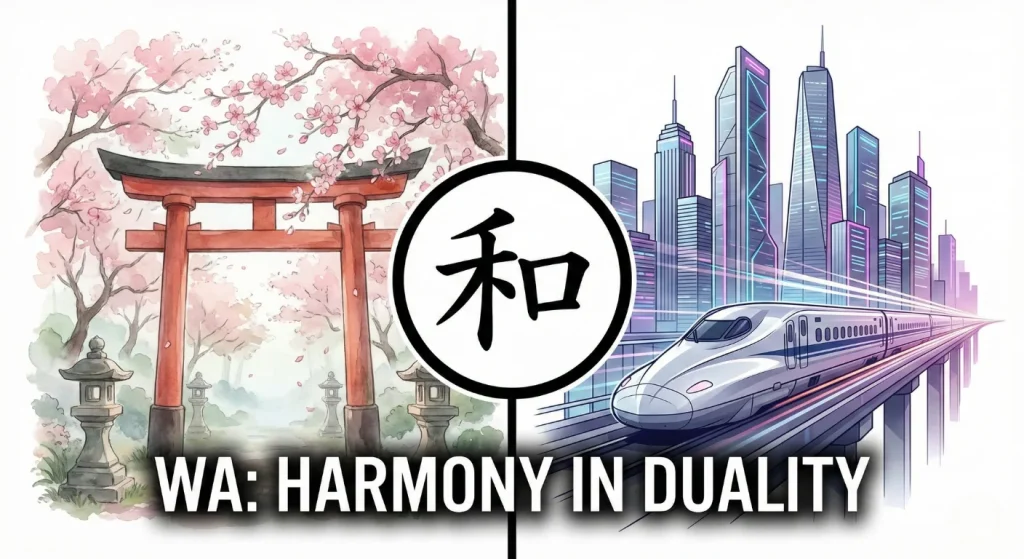
This culture is influenced by Shinto, Buddhism, and Confucian thought, which guide attitudes toward nature, social roles, and behavior. These values appear in everyday practices such as bowing, gift-giving, seasonal festivals, and careful attention to etiquette. They also appear in cultural expressions like tea ceremonies, martial arts, anime, manga, and design. Modern technology and pop culture exist alongside tradition, not in opposition, creating a society that respects the past while adapting to the present.
What Are the Core Values and Social Structure in Japan?
Japanese social values focus on harmony (wa), group stability, and respect for order. People often avoid open conflict to protect relationships within families, workplaces, and communities. Collectivism shapes behavior, where group needs come before personal preference. Social roles matter, and individuals adjust actions to fit shared expectations.
This structure relies on respect and hierarchy, shown through language, bowing, and decision-making flow. Age, role, and seniority guide interaction in schools and companies. Purity and cleanliness, rooted in Shinto, appear in daily habits, public spaces, and design choices. These values support predictable behavior, smooth coordination, and trust across society.
What Role Do Religion and Spiritual Beliefs Play in Japanese Culture?
Religion in Japan functions as a lived practice rather than strict belief. Shinto and Buddhism coexist and guide different life stages. People often visit Shinto shrines for births, weddings, and seasonal events. Buddhist temples handle funerals and remembrance, shaping attitudes toward life and death.
Zen Buddhism influences behavior and aesthetics through simplicity, focus, and calm. Its ideas appear in gardens, tea rooms, martial arts, and creative work. Many people follow rituals without labeling themselves religious. This flexible approach allows spiritual customs to blend into daily life without conflict or rigid doctrine.
What Are the Main Traditional Arts and Cultural Practices in Japan?
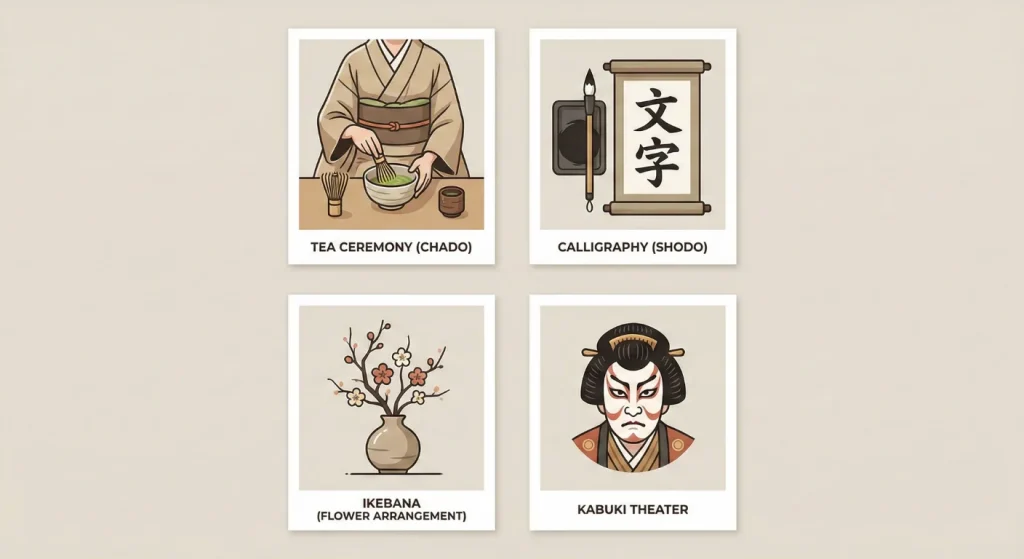
Traditional culture in Japan values discipline, form, and repetition. Ikebana, origami, calligraphy, Kabuki, and Noh theatre focus on control, balance, and meaning. The tea ceremony (Chanoyu) reflects patience, respect, and attention to detail through structured movement and shared space.
Cuisine emphasizes seasonal ingredients, freshness, and presentation, seen in sushi, ramen, and plant-forward dishes. Martial arts such as Judo, Karate, Kendo, and Sumo combine physical skill with mental focus. Matsuri festivals, including Hanami, connect communities to local shrines and seasonal cycles.
How Does Modern Culture and Innovation Shape Japan Today?
Modern Japan blends tradition with change through design, media, and technology. Anime, manga, J-Pop, and video games shape global pop culture while reflecting local themes. These formats influence storytelling, fashion, and youth identity across generations.
Japan also leads in technology, applying robotics, transport systems, and digital tools with care for usability and form. Fashion and design range from classic kimonos to bold street styles in Harajuku. This mix shows how innovation adapts tradition rather than replacing it.
How Does Japanese Culture Influence Daily Life and Social Etiquette?
Daily behavior in Japan follows clear social rules. Bowing signals respect in greetings, thanks, and apologies. People use indirect communication to avoid discomfort and protect harmony. Words often soften disagreement, especially in workplaces and public settings.
Punctuality shows respect for others’ time and shared responsibility. Trains, meetings, and schedules reflect this norm. Gift-giving supports relationships in business and personal life, often tied to travel or milestones. These habits guide interaction and help maintain trust in everyday situations.
How Has Japanese Culture Evolved Throughout History?
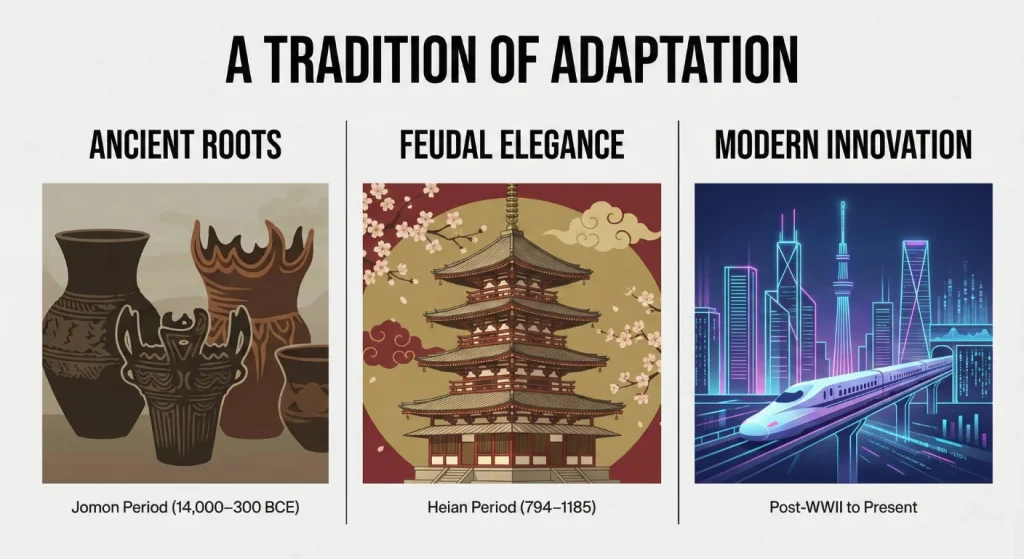
Japan’s cultural evolution represents one of the world’s most fascinating historical journeys, spanning thousands of years of rich traditions, societal transformations, and technological progress.
From prehistoric settlements to its position as a global cultural powerhouse, Japan’s development showcases remarkable adaptability while maintaining strong connections to its heritage.
| Historical Period | Key Features and Developments | Cultural Highlights | Key Locations/Artifacts |
|---|---|---|---|
| Ancient Japan (Jomon, Yayoi) | – Jomon Period (14,000–300 BCE): Hunter-gatherers with intricate pottery, pit houses, and nature-based religious practices. – Yayoi Period (300 BCE–300 CE): Introduction of rice cultivation, social hierarchies, and bronze/iron tools. | – Jomon pottery with rope patterns. – Jade jewelry and ceremonial objects. | Sannai-Maruyama ruins (Aomori Prefecture) |
| Feudal Japan (Heian, Kamakura) | – Heian Period (794–1185): Cultural golden age, courtly arts, and literature (e.g., “The Tale of Genji”). – Kamakura Period (1185–1333): Rise of samurai class, spread of Buddhism, and development of warrior tales. | – Development of shoin-zukuri architecture. – Tea ceremony and emaki scrolls. | Kyoto (Heian architecture), Kamakura temples |
| Modernization (Meiji Restoration, Post-WWII) | – Meiji Restoration (1868): Rapid modernization, Western influence on clothing, industry, and governance. – Post-WWII: Democratic reforms, technological advances, and urbanization. | – Blend of traditional arts (kabuki, ikebana) with global pop culture (anime, manga). | Tokyo (modern skyline), traditional districts (Asakusa, Kyoto) |
Ancient Japan (Jomon, Yayoi periods)
The Jomon period (14,000-300 BCE) marked Japan’s earliest cultural development. These hunter-gatherers created intricate pottery decorated with rope patterns, which gave the period its name. Archaeological findings reveal sophisticated settlements with pit houses and early religious practices centered around natural phenomena. The Jomon people crafted tools from stone and bone, showing remarkable skill in working with available materials.
The transition to the Yayoi period (300 BCE-300 CE) brought significant changes through the introduction of rice cultivation from mainland Asia. This agricultural revolution transformed Japanese society, leading to the establishment of permanent settlements and social hierarchies. Bronze and iron tools appeared during this time, advancing farming techniques and military capabilities.
Archaeological sites like the Sannai-Maruyama ruins in Aomori Prefecture provide evidence of complex social structures during these periods. Artifacts include jade jewelry, ceremonial objects, and remains of large buildings, suggesting organized communities with distinct social roles and religious practices.
Feudal Japan (Heian, Kamakura periods)
The Heian period (794-1185) represented Japan’s classical golden age. The imperial court in Kyoto developed sophisticated artistic expressions, including literature and calligraphy. Lady Murasaki Shikibu wrote “The Tale of Genji,” often considered the world’s first novel, offering insights into court life and social customs.
During the Kamakura period (1185-1333), the samurai class rose to prominence, establishing a new social order based on martial values and loyalty. Buddhism spread widely among all social classes, with new sects making religious teachings accessible to common people. Art forms like emaki (painted hand scrolls) and warrior tales gained popularity.
These periods saw the refinement of distinctive Japanese cultural elements. Architecture evolved with the development of shoin-zukuri style, featuring tatami floors and sliding doors. The tea ceremony emerged as a sophisticated cultural practice, combining aesthetic appreciation with spiritual elements.
Modernization (Meiji Restoration, post-WWII)
The Meiji Restoration (1868) launched Japan into rapid modernization. The government sent scholars abroad to study Western systems, leading to widespread reforms in education, industry, and governance. Traditional clothing gave way to Western fashions, while railways and modern factories transformed the landscape.
Post-WWII Japan experienced dramatic social and economic changes. The American occupation introduced new democratic values and social reforms. Japan’s economic miracle of the 1960s and 1970s brought unprecedented technological advancement and urbanization, changing family structures and work practices.
Modern Japanese culture reflects this complex heritage. Traditional arts like kabuki theater and flower arrangement continue alongside global pop culture phenomena like anime and manga. Urban centers showcase cutting-edge technology while maintaining historical districts with centuries-old temples and gardens.
The evolution of Japanese culture demonstrates remarkable continuity despite massive changes. Each period built upon previous achievements while adapting to new challenges, creating a unique cultural identity that balances tradition with innovation. Today’s Japan continues this pattern, preserving cultural heritage while embracing contemporary global influences.
How Has Shinto And Buddhism Shaped Japanese Culture?
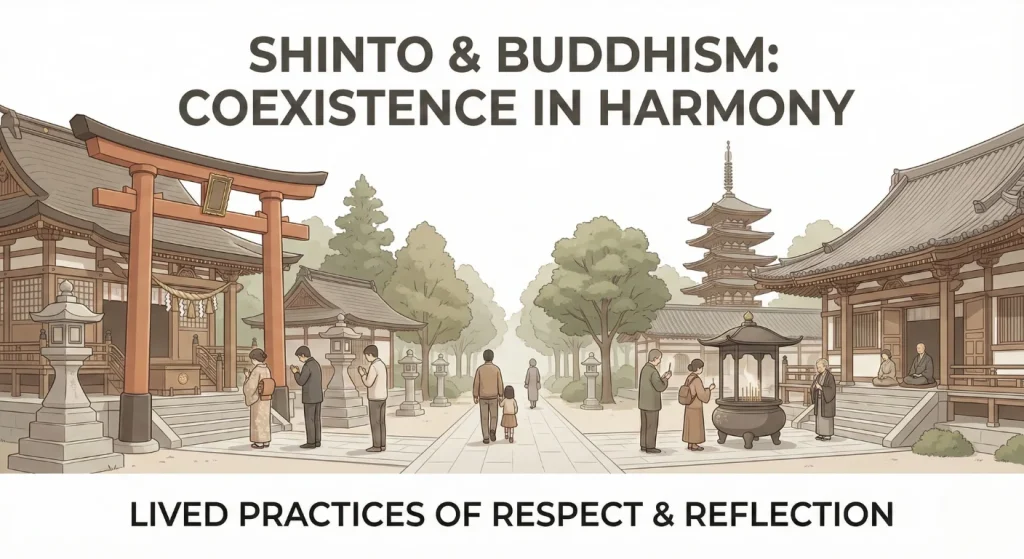
Shinto and Buddhism have profoundly shaped Japanese cultural traditions, weaving together to create a unique spiritual tapestry that influences daily life in Japan.
Shinto, Japan’s indigenous religion, emerged from ancient nature worship and focuses on the reverence of kami (spirits) present in natural elements, while Buddhism arrived from China in the 6th century, bringing philosophical teachings about life, death, and enlightenment.
Shinto rituals celebrate life’s key moments through festivals and ceremonies at thousands of shrines across the Japanese islands, often inspired by the country’s awe-inspiring natural landscapes. For more about Japan’s Volcanic Geography and its connection to culture.
Meanwhile, Buddhist temples serve as centers for both spiritual practice and architectural beauty, featuring distinctive elements like pagodas and zen gardens. The influence of Buddhism is particularly visible in Japanese art forms, from bonsai trees to ikebana (flower arranging), which reflect Buddhist principles of mindfulness and harmony with nature.
Key Religious Influences on Japanese Culture:
- Shrine Architecture: Distinctive torii gates and shrine designs
- Seasonal Festivals: Cherry blossom viewing (hanami) and summer festivals (natsu matsuri)
- Daily Practices: Morning offerings, shrine visits, and prayer rituals
- Art Forms: Zen gardens, temple architecture, and religious statuary
- Cultural Values: Respect for nature, ancestor veneration, and group harmony
Modern Japanese society continues to embrace these religious traditions while adapting them to contemporary life. Many Japanese families maintain small Buddhist altars (butsudan) in their homes for ancestor veneration, while also celebrating Shinto festivals throughout the year.
This blend of Shinto and Buddhist practices demonstrates Japan’s unique ability to preserve cultural traditions while embracing modern lifestyles.
What Role Does Art Play In Japanese Culture?
Art in Japanese culture serves as a profound expression of both tradition and innovation, weaving together centuries of aesthetic principles with modern interpretations. From the elegant brushstrokes of calligraphy to the vibrant world of contemporary manga, Japanese art forms reflect the nation’s deep appreciation for beauty, nature, and cultural preservation.
Traditional Japanese art emphasizes harmony with nature and the beauty of imperfection, as seen in the practice of kintsugi (金継ぎ), where broken pottery is repaired with gold. The influence of natural elements appears throughout Japanese artistic expressions, from the delicate flower arrangements of ikebana (生け花) to the flowing landscapes depicted in sumie (墨絵) ink paintings. These art forms often incorporate seasonal motifs, such as cherry blossoms and Mount Fuji, connecting artistic expression to the natural world.
Here are the significant traditional Japanese art forms that continue to shape cultural identity:
- Kabuki (歌舞伎) – Classical dance-drama known for elaborate costumes and makeup
- Noh (能) – Traditional masked theater dating back to the 14th century
- Bunraku (文楽) – Sophisticated puppet theater with narrative chanting
- Ukiyo-e (浮世絵) – Woodblock prints depicting scenes from daily life
- Sumie (墨絵) – Monochrome ink painting emphasizing simplicity
- Kintsugi (金継ぎ) – The art of repairing broken pottery with gold
- Origami (折り紙) – Paper folding art creating various designs
- Ikebana (生け花) – The art of flower arrangement
- Shibori (絞り染め) – Traditional cloth dying technique creating patterns
How Does Food Reflect Traditional Japanese Culture?
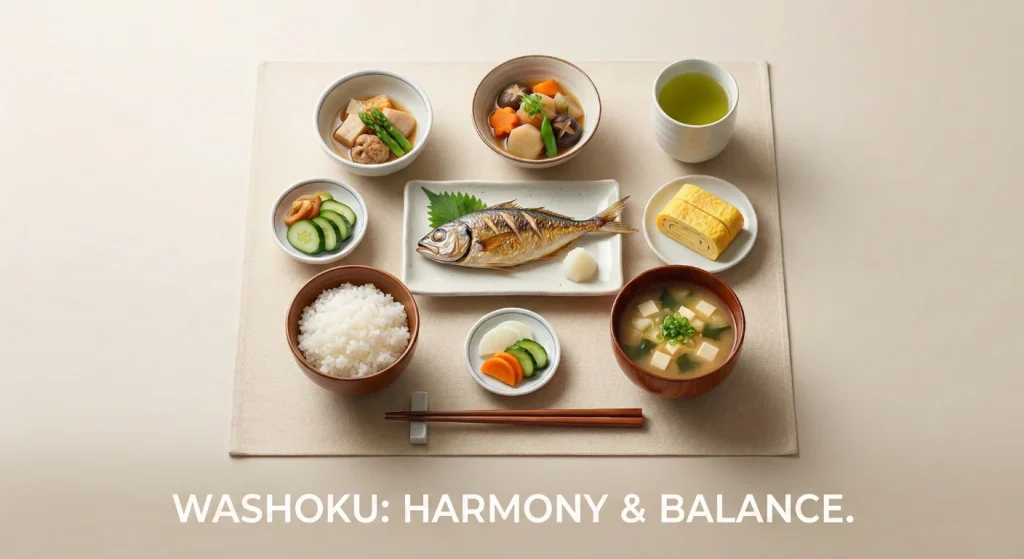
Traditional Japanese cuisine, known as washoku, centers on the principles of seasonality (shun), balance, and artistic presentation. This culinary philosophy, recognized as an Intangible Cultural Heritage by UNESCO, emphasizes harmony between nature and food.
The Japanese tea ceremony (chanoyu), perfected by figures like Sen no Rikyū, exemplifies these values, where every movement and detail holds deep cultural meaning. In this ritual, matcha tea is prepared and served with precise steps that reflect respect, harmony, and mindfulness—core Japanese values that have shaped their food culture for centuries.
Rice, miso soup, and seasonal vegetables form the foundation of Japanese meals, with each dish carefully arranged to please both the eye and palate. Regional delicacies, such as Kyoto’s kaiseki cuisine or Hokkaido’s fresh seafood dishes, showcase local flavors and seasonal bounty.
Sushi, perhaps Japan’s most famous culinary export, represents the culture’s deep connection to the sea and commitment to precision, as demonstrated by master chefs like Jiro Ono of Sukiyabashi Jiro. The concept of “mottainai” (avoiding waste) influences how ingredients are used, while seasonal ingredients, such as sakura blossoms in spring and matsutake mushrooms in autumn, highlight nature’s changing beauty.
What Are The Most Important Festivals In Japanese Culture?
Japanese festivals (matsuri) serve as vital links between past and present, bringing communities together through shared traditions and celebrations.
Here are the most significant festivals in Japanese culture:
- Shogatsu (New Year’s Festival): The most important holiday, featuring special foods, temple visits, and family gatherings
- Hanami (Cherry Blossom Festival): Spring celebration marking nature’s renewal
- Obon: Summer festival honoring ancestors with lanterns and traditional dance
- Tanabata (Star Festival): July celebration based on an ancient love story
- Gion Matsuri (Kyoto): Month-long summer festival with grand parades
- Setsubun: Spring arrival celebration with bean-throwing customs
- Tori no Ichi: November festival for good fortune and business success
These festivals blend religious traditions, seasonal changes, and community spirit, often featuring traditional crafts, local foods, and performances that help preserve Japanese cultural heritage for future generations.
How Have Samurai And Martial Arts Influenced Japanese Culture?
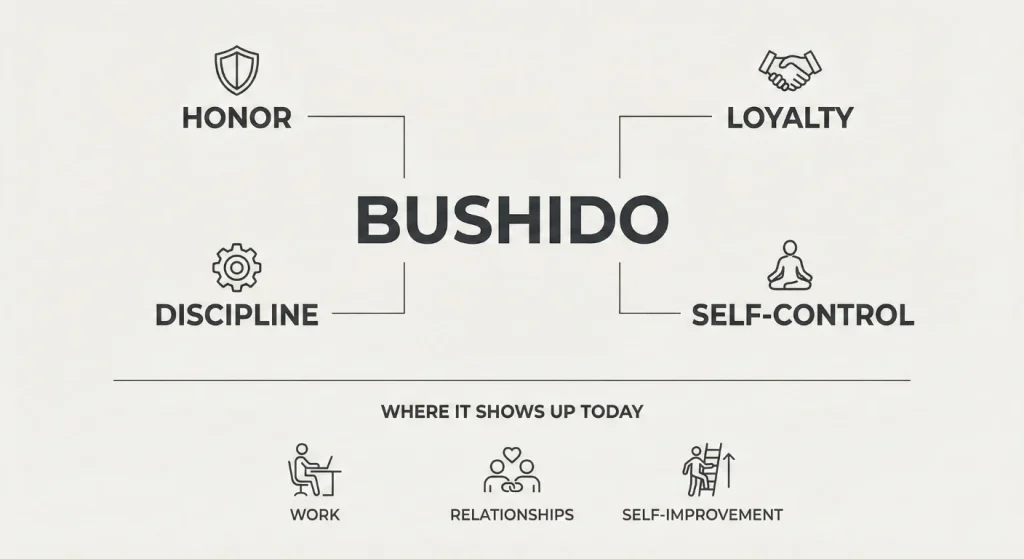
The samurai culture and martial arts have left an indelible mark on Japanese society, shaping values that continue to influence modern life. The elite warrior class, which emerged in the 11th century, developed a strict code of conduct called bushido, emphasizing honor, loyalty, discipline, and self-control. These principles remain deeply woven into Japan’s social fabric, affecting everything from business practices to personal relationships.
Japanese martial arts, known as budo, carry forward the samurai’s spiritual and physical traditions. Popular disciplines like judo (the gentle way), kendo (the way of the sword), and karate (empty hand) blend physical techniques with mental training and character development.
tional principles before practice, maintaining centuries-old customs. These martial arts have evolved beyond their combat origins to become respected sports that teach patience, respect, and perseverance.
The influence of samurai values extends into everyday life in Japan, where concepts like gaman (endurance) and gambaru (doing one’s best) reflect the warrior’s dedication to self-improvement. Today, many Japanese companies incorporate martial arts training into their employee development programs, recognizing how these ancient practices build teamwork and leadership skills. Even Japanese students often participate in martial arts clubs at school, learning discipline and respect while connecting with their cultural heritage.
How Has Traditional And Modern Fashion Influenced Japanese Culture?
Japanese fashion represents a fascinating blend of traditional elegance and modern innovation, creating a unique cultural identity that influences global style trends. The kimono, Japan’s iconic traditional garment, continues to inspire both domestic and international designers with its flowing silhouettes and intricate patterns. Traditional elements like bright colors and flower designs often appear in contemporary Japanese fashion, bridging the gap between past and present.
Modern Japanese street fashion, particularly in Tokyo’s Harajuku district, has transformed how the world views Asian fashion. Young designers mix traditional Japanese elements with Western influences, creating bold new styles that reflect Japan’s ability to adapt while preserving cultural heritage.
This fusion appears in popular brands that incorporate simple kimonos patterns into casual wear, or use traditional textile techniques in modern clothing. The influence extends beyond clothing, as traditional accessories like obi-inspired belts and geta-influenced footwear find their way into contemporary collections.
The global fashion industry has embraced Japanese design principles, from minimalist aesthetics to attention to detail. Major fashion houses regularly draw inspiration from Japanese elements, while Japanese designers like Issey Miyake and Yohji Yamamoto have become international fashion icons.
Their work often reflects Japanese values of simplicity and craftsmanship, showing how traditional concepts can evolve into modern expressions. This cultural exchange has positioned Japan as a leading force in global fashion, where traditional values and modern innovation create unique and influential styles.
What Are the Key Differences Between Traditional and Modern Japanese Lifestyles?
Traditional and modern Japanese lifestyles represent two distinct approaches to daily living, shaped by rapid economic growth and technological advancement. The shift from rural to urban life has transformed how Japanese people live, work, and interact with their communities, creating a striking contrast between old and new ways of life.
In traditional rural Japan, families typically lived in wooden houses with tatami mat floors, following a simple life centered around farming and close community ties. Family roles were clearly defined, with multiple generations living together under one roof, sharing family activities and maintaining Japanese traditions like tending to small gardens and participating in local festivals.
Daily routines revolved around agricultural cycles, with early morning starts and work directly connected to the land. These communities often practiced Japan’s “mottai-nai” concept, which emphasizes avoiding waste and respecting resources.
Modern urban Japanese life, however, presents a dramatic shift from these traditional patterns. Today’s Japanese city dwellers often live in compact apartments equipped with the latest technology, working long hours in office buildings rather than fields. Family structures have become smaller, typically consisting of nuclear families or single-person households.
Daily routines now center around commuting, office work, and digital connectivity. While some traditional elements remain, such as removing shoes indoors and celebrating cultural festivals, urban Japanese people balance these customs with contemporary conveniences like convenience stores, automated services, and fast-paced entertainment options.
What Are The Core Values Of Japanese Culture?
Japanese culture rests on several key values that shape daily life, social interactions, and personal behavior. These core principles, deeply influenced by historical periods like the Edo era, continue to shape modern Japanese society, from the bustling offices of Shinjuku in Tokyo to tranquil villages in Hokkaido. The concept of “wa” (harmony) stands as a central pillar of Japanese cultural values, guiding people to maintain peaceful relationships and avoid conflict.
In the workplace, this translates to employees prioritizing group success over individual achievement, a practice rooted in traditions like those of the Tokugawa shogunate, which emphasized collective stability. In family life, it means considering the needs of all members before making decisions.
Respect, another fundamental value, manifests in countless daily interactions through proper bowing, honorific language, and careful attention to social hierarchy. This respect extends beyond human relationships to include nature and objects, as seen in Shinto rituals and customs like the meticulous wrapping of gifts or the aesthetic philosophy of wabi-sabi, which celebrates simplicity and impermanence.
Diligence and perseverance shape the Japanese approach to work and personal development. Students often stay after school for extra study and club activities, while workers commonly put in long hours to perfect their craft, echoing the spirit of bushido, the way of the warrior.
This dedication is evident in traditional arts like tea ceremony and calligraphy, where practitioners, inspired by figures such as Sen no Rikyū, spend years mastering basic techniques. Even in modern Japan, these values remain strong, though younger generations balance them with new perspectives on work-life balance and personal fulfillment.
How Do Language And Literature Reflect Japanese Culture?
The Japanese language directly reflects the culture’s deep respect for social hierarchy and relationships through its complex honorific system called keigo. This linguistic framework includes specific verb forms and vocabulary that change based on the speaker’s relationship to the listener, their social status, and the formality of the situation. Common examples include using “いただきます” (itadakimasu) before meals to express gratitude and “お疲れ様です” (otsukaresama desu) to acknowledge others’ hard work.
Japanese literature serves as a historical mirror of cultural values, from classical works to modern novels. The Tale of Genji, written by Murasaki Shikibu in the 11th century, stands as the world’s first novel and portrays the intricate social customs, emotional restraint, and aesthetic sensibilities that still influence Japanese society today. The work introduced concepts like “mono no aware” (the pathos of things) and “wabi-sabi” (finding beauty in imperfection), which remain central to Japanese artistic expression.
Modern Japanese authors like Haruki Murakami and Banana Yoshimoto continue this cultural reflection through their works, blending traditional Japanese literary elements with contemporary themes. Their stories often feature uniquely Japanese concepts such as “uchi” (inside/private) and “soto” (outside/public), while addressing modern social issues like isolation in urban spaces and the tension between traditional values and modern lifestyles. This literary evolution shows how Japanese culture maintains its core identity while adapting to social change.
How Do Regional Differences Influence Japanese Culture?
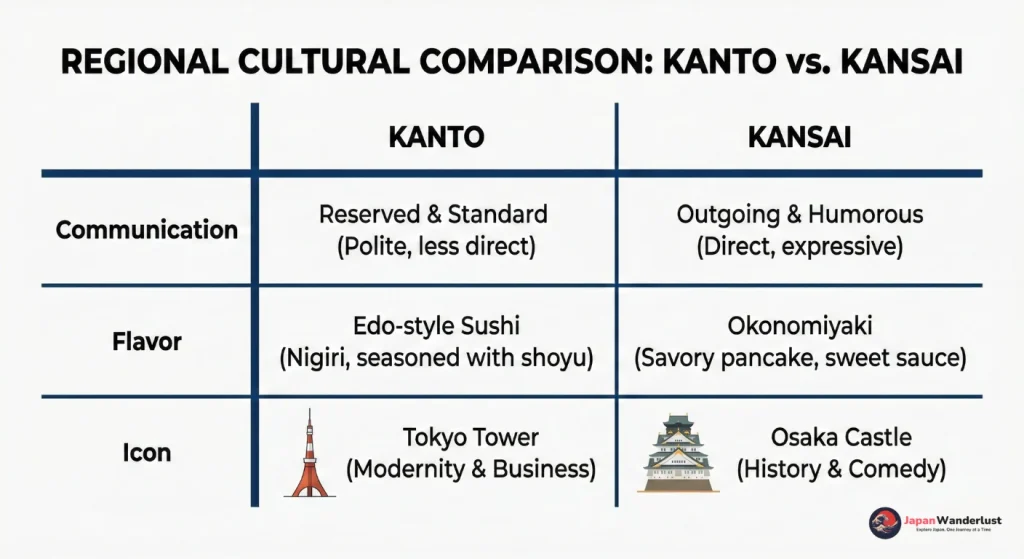
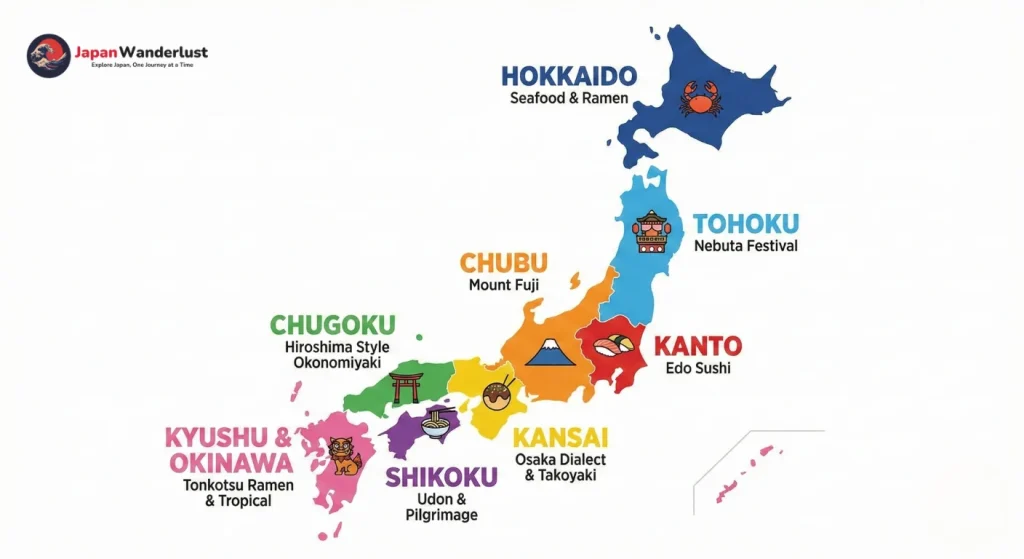
Regional differences play a significant role in shaping Japanese culture, creating distinct identities across the country’s 47 prefectures. Discover Japan’s Cultural Regions to learn more about famous regions, their unique highlights, and geographic significance.
From the snowy landscapes of Hokkaido to the tropical islands of Okinawa, each region has developed its own unique cultural expressions through centuries of local traditions and geographic isolation.
The table below showcases key regional cultural distinctions across Japan:
| Region | Dialect | Cuisine | Notable Traditions |
|---|---|---|---|
| Kansai | Osaka-ben | Okonomiyaki, Takoyaki | Bunraku puppet theater |
| Tohoku | Tohoku-ben | Wanko soba, Kiritanpo | Nebuta Festival |
| Kyushu | Hakata-ben | Tonkotsu ramen, Mentaiko | Hakata Gion Yamakasa |
| Okinawa | Uchinaguchi | Goya champuru, Rafute | Eisa dance, Ryukyu music |
| Kanto | Standard Japanese | Monjayaki, Dojo nabe | Kabuki theater |
These regional variations extend beyond surface-level differences, influencing daily life and social interactions.
For example, the Kansai region is known for its outgoing, humorous communication style, while Tokyo’s Kanto region tends toward more reserved interactions. Local festivals (matsuri) also reflect these distinctions, with each region celebrating its own historical events, seasonal changes, and cultural heroes through unique ceremonies and performances.
Modern Influences on Japanese Culture
Japan stands as a remarkable example of how traditional values can blend with contemporary global influences. The nation’s ability to adapt and integrate international elements while maintaining its cultural identity has created a distinctive modern society that fascinates people worldwide.
Japan’s popular culture now shapes how many younger travelers first imagine the country. Anime, manga, J-Pop, video games, street fashion, character goods, and social media all create entry points into Japanese culture before someone ever visits. This global pull also helps explain why Gen Z is so obsessed with Japan, especially when modern pop culture is experienced alongside temples, food, design, and everyday traditions.
Popular Culture (Anime, J-Pop, Technology)
Japanese animation (anime) has grown from a local entertainment medium to a global cultural phenomenon. Studios like Studio Ghibli and production houses such as MAPPA have created works that resonate with audiences across cultural boundaries. Shows like “Attack on Titan” and “My Hero Academia” draw millions of viewers worldwide, influencing art styles, storytelling methods, and entertainment preferences globally.
The J-Pop industry represents another significant cultural export. Japanese music groups and solo artists have built dedicated fan bases throughout Asia and beyond. The rise of groups like AKB48 and BABYMETAL shows how Japanese pop culture combines traditional elements with modern entertainment formats. These artists often mix Japanese musical traditions with contemporary Western pop styles, creating unique sounds that appeal to international audiences.
Japan’s technological innovations continue to shape global consumer electronics and digital entertainment. Companies like Sony and Nintendo have transformed gaming culture worldwide. The Pokemon franchise demonstrates how Japanese creativity merges gaming, animation, and merchandise into comprehensive entertainment experiences. Japanese technological advances in robotics, particularly in human-assist robots and artificial intelligence, showcase the nation’s forward-thinking approach to solving social challenges.
The fusion of these elements creates unique cultural expressions. Modern Japanese street fashion often incorporates anime-inspired designs with traditional patterns. Gaming cafes combine traditional tea house concepts with digital entertainment. This mixing of old and new elements shows how Japan maintains cultural authenticity while embracing global influences.
Japanese popular culture’s influence extends into social media and digital communication. Emoji, originally created in Japan, have become a universal digital language. Video sharing platforms feature countless creators inspired by Japanese pop culture, spreading these influences to new generations of fans worldwide.
These modern influences have created a feedback loop where international appreciation of Japanese culture inspires new creative works within Japan. This cultural exchange continues to evolve, making Japanese popular culture a dynamic force in global entertainment and technology.
What Are The Key Etiquette Practices And Social Customs In Japanese Culture?
Japanese etiquette practices form the backbone of social interactions in Japan, built on principles of respect, harmony, and consideration for others. These customs range from basic greetings to complex social protocols that govern daily life and special occasions.
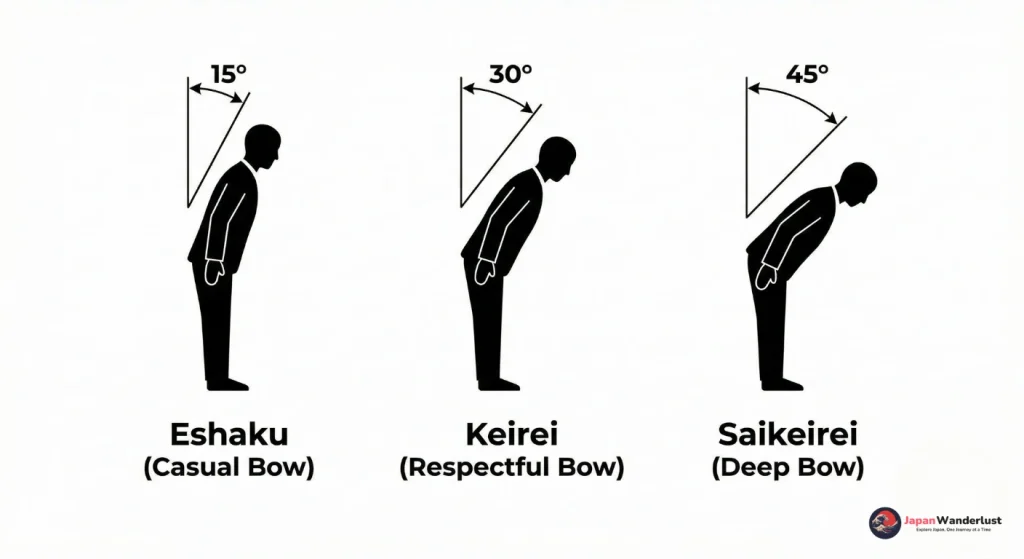
The art of bowing (ojigi) stands as Japan’s fundamental greeting, with different bow angles indicating varying levels of respect – 15 degrees for casual greetings, 30 degrees for business, and 45 degrees for deep apologies or showing profound respect.
Gift-giving (zōtō) plays a vital role in Japanese relationships, where the presentation manner often matters more than the gift itself. Visitors should note that gifts are given and received with both hands, and opening presents immediately is considered impolite.
Do’s in Japanese Culture:
- Remove shoes before entering homes or certain establishments
- Present and receive items with both hands
- Wait for everyone to say “itadakimasu” before eating
- Pour drinks for others in your group
- Use chopsticks properly (no pointing or passing food)
Don’ts in Japanese Culture:
- Blow your nose in public
- Eat while walking
- Leave chopsticks standing vertically in rice
- Be late for appointments
- Enter a bathtub without washing first
- Tip at restaurants (considered unnecessary and sometimes offensive)
The concept of omotenashi (Japanese hospitality) ties these practices together, emphasizing selfless service and anticipating others’ needs before they arise. This attention to detail and consideration for others defines the social environment Japan is known for.
How To Show Respect In Japanese Culture?
Respect (敬意, keii) forms the cornerstone of Japanese social interactions, manifesting through specific behaviors, language choices, and non-verbal cues. Japanese culture operates on a hierarchical system where age, social status, and professional position determine the appropriate level of respect in any given situation.
The Japanese language reflects respect through keigo (敬語), a complex system of honorific speech patterns used based on social context. In business settings, employees use sonkeigo (尊敬語) to show deference to superiors and kenjōgo (謙譲語) to humble themselves when speaking about their own actions. Basic respect practices include bowing at appropriate angles (15 degrees for casual greetings, 30 degrees for business, 45 degrees for deep apology), arriving 10-15 minutes early for appointments, and exchanging business cards (meishi) with both hands while facing the recipient.
Daily interactions require constant awareness of social hierarchy and appropriate behavior. This includes stepping aside for older people, using proper name suffixes (-san, -sama, -sensei), and avoiding direct confrontation or disagreement. Foreign visitors can show respect by learning basic Japanese greetings, removing shoes before entering homes, and accepting items with both hands. These practices help create harmonious relationships and demonstrate cultural sensitivity in both formal and informal settings.
Why Is Japan’s Culture So Unique?
Japan’s cultural uniqueness stems from its 2,000-year history of selective adaptation, where foreign influences are carefully filtered and transformed into distinctly Japanese forms. The nation’s geographical isolation as an island archipelago allowed it to develop independently while choosing which external elements to incorporate, from Chinese characters in the 5th century to Western technology in the modern era.
This selective adaptation is evident in how Japan seamlessly blends ancient traditions with contemporary life. In Tokyo, centuries-old temples stand beside sleek skyscrapers, while traditional tea ceremonies continue in modern offices. The imperial family maintains its position as a cultural symbol, preserving rituals that date back to the 17th century, while Japanese innovation leads global technology trends. The country’s seasonal festivals (matsuri) demonstrate this fusion, where traditional Shinto ceremonies merge with modern entertainment, drawing millions of participants annually.
The Japanese aesthetic principle of “wa” (harmony) shapes this cultural duality, creating a society where old and new complement rather than conflict. This is visible in Japanese art forms like ikebana (flower arrangement) and architecture, which maintain traditional principles while incorporating contemporary elements. Even in daily life, this balance appears in how Japanese people switch naturally between wearing summer kimonos at festivals and business suits at work, or how they observe ancient customs like hanami (cherry blossom viewing) using smartphone apps to track the best viewing times.
Experience Japanese Culture the Right Way in Tokyo
Japanese culture is not something you finish reading about and fully understand. You feel it in small moments: how people move through a train station, how a shrine visit is done quietly, how food is presented, and how neighborhoods shift from old to new within a few blocks. With more context, those moments carry more meaning. That understanding also makes it easier to travel respectfully and with confidence in Tokyo.
If you want to turn what you learned here into a real, low-stress experience, working with a private Tokyo tour guide is one of the simplest options. You can visit important cultural spots without rushing, ask questions as they come up, and adjust the day to match your pace. For families, this approach works especially well. It reduces logistics, cuts down on constant decision-making, and follows a route that makes sense with kids.
Planning beyond Tokyo? We can also help with a Japan private tour that connects cultural highlights across regions, while keeping the trip practical and well paced from the start in Japan.
Ready to plan?
Explore our Tokyo private tour for families, or get in touch to design a smooth, well-paced experience built around your dates, interests, and travel style.