
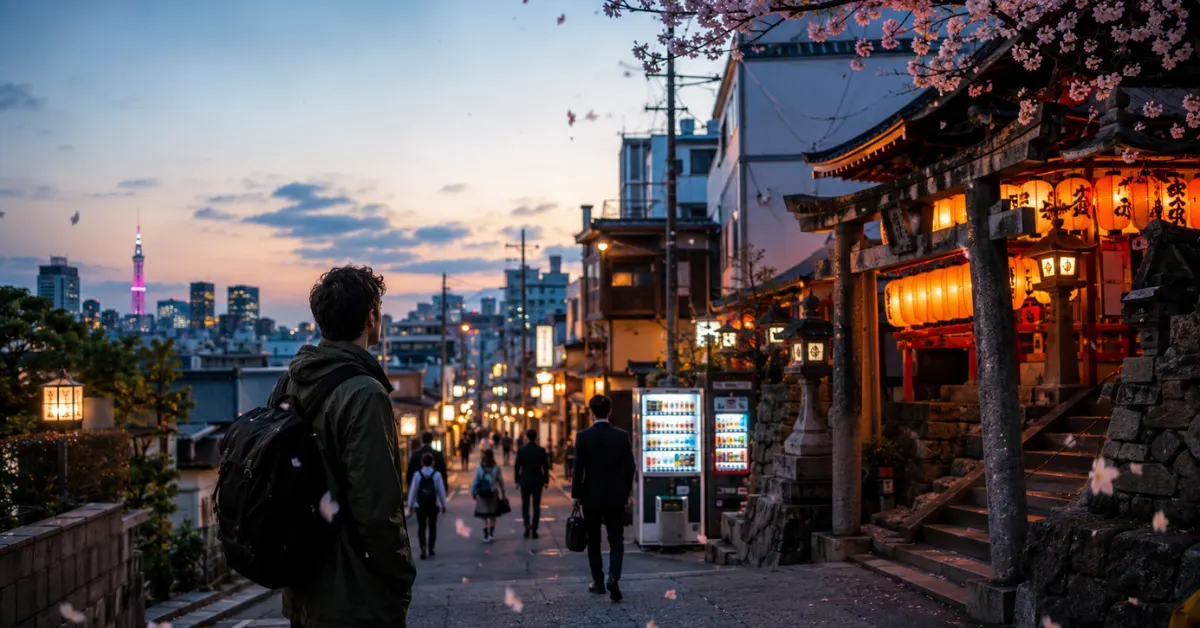
People romanticize Japan because three different pulls are landing at once. A distinct aesthetic and natural landscape draws part of the fascination. Decades of pop culture exports, anime and manga among them, shaped how millions of people first pictured the country.
A reputation for order and cleanliness adds a third pull. It reads as relief to visitors frustrated with the same things at home. For many younger travelers active on social media, loving Japan has become a way to picture a calmer life.
That picture is not wrong. It is not the whole country. The gap between the two is worth understanding before you go.
Why do people romanticize Japan so much?
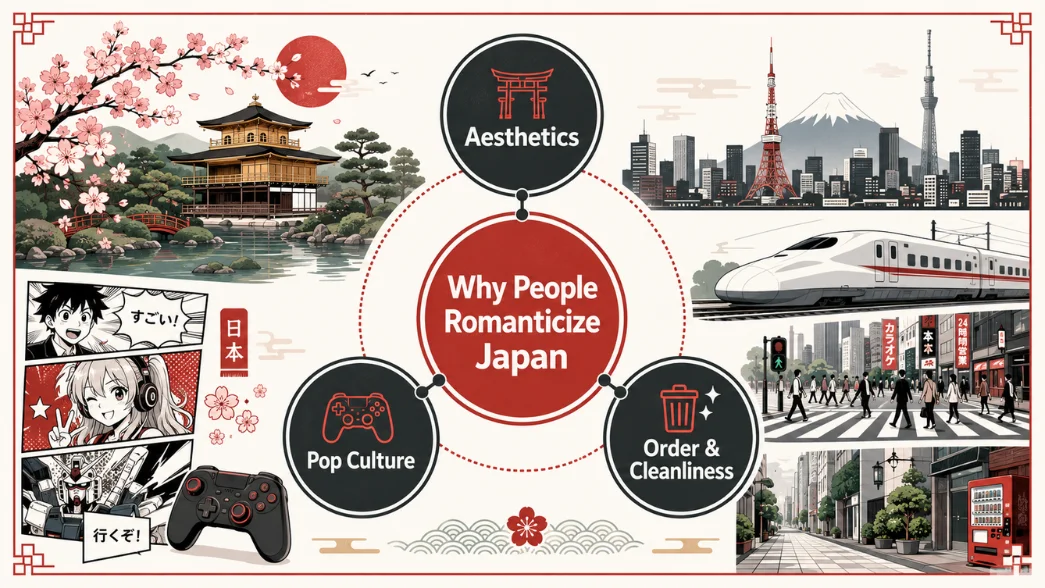
The fascination comes from three things landing at once. A specific visual aesthetic draws part of the pull, from moss temple gardens to a Tokyo intersection engineered to move thousands without chaos. Pop culture exports did the rest of the work over decades, introducing entire generations to the country before they ever booked a flight.
- A visual and natural aesthetic that looks distinct from home.
- Pop culture exports, anime, manga, and games, that shaped early impressions.
- A sense of public order that reads as relief by comparison.
Not every reader responds to all three pulls equally. Someone drawn to Kyoto’s gardens might never have opened a manga. Someone who grew up on a specific anime might have zero interest in gardens at all.
Aesthetic and sensory appeal
A lot of the pull is visual and sensory. Ryoan-ji’s rock garden in Kyoto uses raked gravel and fifteen stones arranged so that one stone stays hidden from any single viewing angle. That kind of restraint is not something most visitors encounter at home.
Seasonal customs work the same way. Hanami, cherry blossom viewing, turns a two-week window into a nationally tracked event. Forecasters track bloom dates the way meteorologists track storms.
Train design carries the same logic. The Tokaido Shinkansen, the bullet train line linking Tokyo, Kyoto, and Osaka, has a long nose that exists to cut tunnel boom noise. The engineering fix became its most recognizable shape.
Pop culture’s soft power
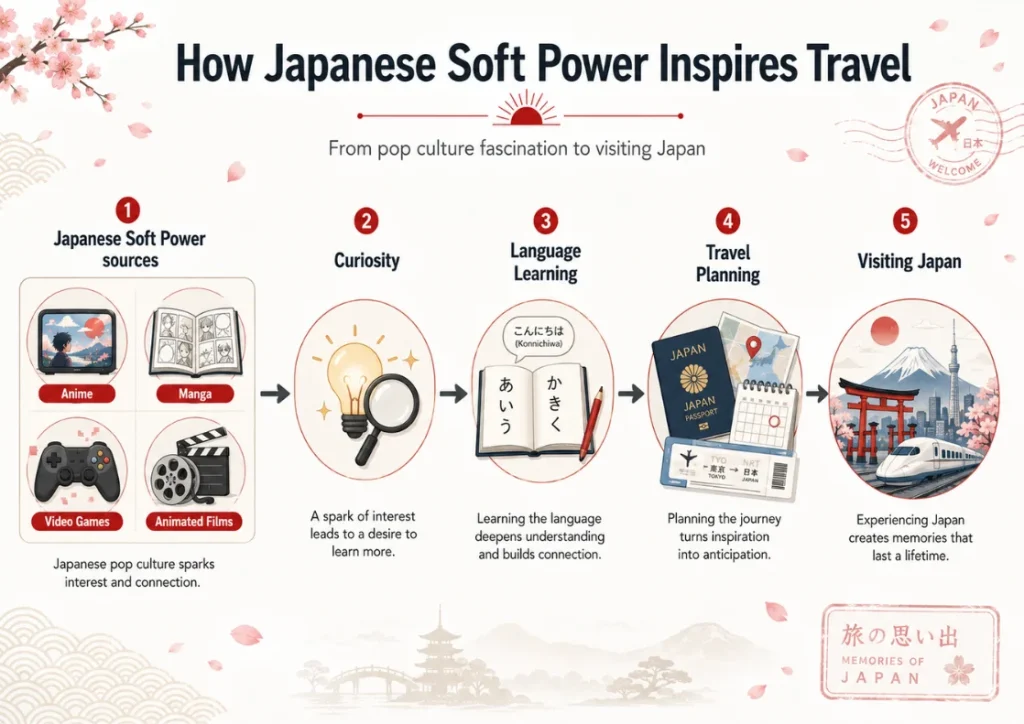
For many people under 40, the first version of Japan they ever encountered came through anime, manga, or a video game. That early exposure came before any travel article, guidebook, or documentary. It shaped how they pictured the country for years afterward.
Political scientist Joseph Nye named this kind of influence soft power. It means cultural appeal that builds affection before any policy or advertisement gets involved. Japan’s anime and gaming exports are often cited as some of the clearest examples.
Someone who grew up on a specific show, a Ghibli film or a long-running shonen series, often pictures Japan through that lens first. A trip later becomes a way to see the source material in person.
Contrast with everyday frustration back home
Part of the appeal is comparative. Japan’s reputation for cleanliness, low crime, and reliable public transit reads as aspirational to visitors frustrated with those same things at home.
A train that runs on a published schedule and keeps it can feel like proof of something. It suggests a different way of living is real, not aspirational marketing.
This says as much about the visitor’s home country as it does about Japan. A Londoner frustrated with delayed trains and a Californian frustrated with unreliable transit are responding to the same gap, just from different starting points.
Recent reporting frames this exact frustration as a driving factor, part of why Gen Z is so drawn to Japan in particular. It’s one driver among several here, not the whole explanation.
Why do people become obsessed with Japan?
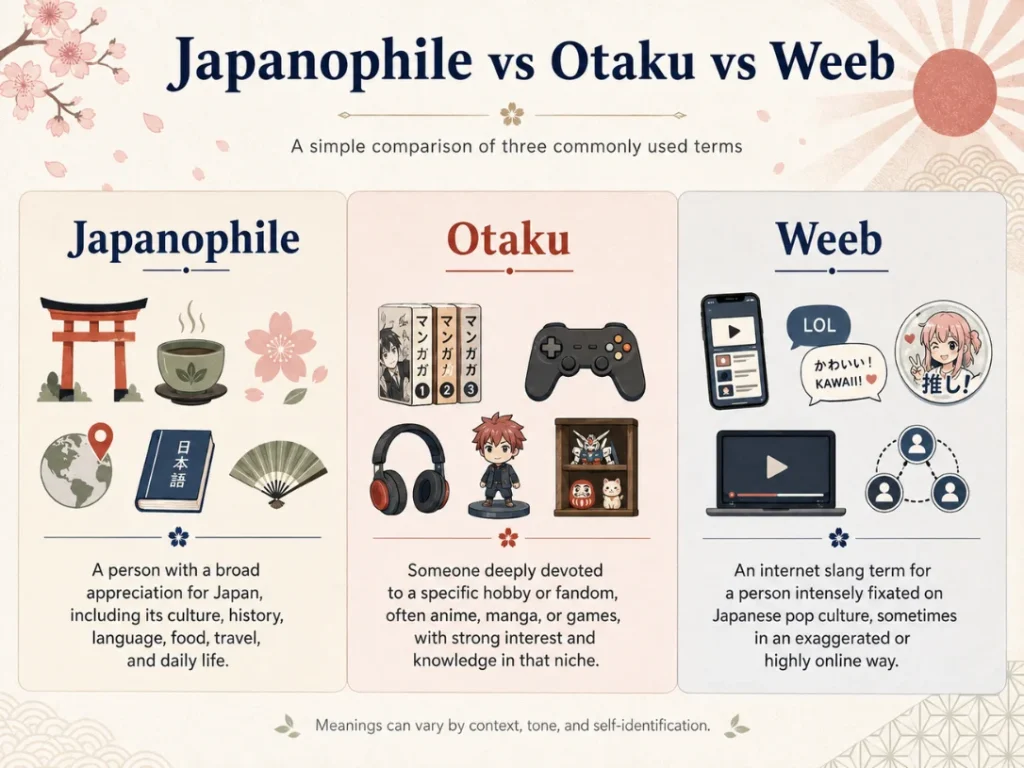
For a smaller group, admiration turns into something closer to identity. The terms people use for that, Japanophile, otaku, weeb, describe different points on one spectrum. They are not three words for the same thing.
| Term | Meaning | Origin |
|---|---|---|
| Japanophile | Broad appreciation for Japanese culture, history, or language | European term predating anime by centuries |
| Otaku | Intense hobbyist interest, often tied to a specific fandom | Term originated in Japan |
| Weeb / Weeaboo | Slang implying excess or a shaky grasp on reality behind the interest | Western internet slang |
None of these labels is an insult by default. Someone can be a Japanophile without ever touching anime.
An otaku doesn’t have to leave their home country either. What actually matters is how someone relates to the country behind the interest.
From casual fan to Japanophile
Japanophile is the oldest and broadest of these terms. It describes genuine appreciation for Japanese culture, history, and language. The word goes back to European writers and collectors, long before anime existed.
Lafcadio Hearn, a Greek-Irish writer, moved to Japan in 1890 and spent the rest of his life writing about it for Western readers. The fascination this article describes has existed in some form for well over a century.
The psychology of the obsession
For many people, the appeal centers on what Japan represents. Order, purpose, and a calmer version of daily life sit at the top of that list. Admiration can turn into escapism because of that gap.
The gap can widen when someone feels disconnected from the version of adulthood modeled at home. Long commutes, expensive housing, and jobs that feel purposeless all play a part. A contrast with the UK’s cost of living or an unaffordable US housing market can make interest in Japan feel personal rather than aesthetic.
Where appreciation tips into caricature
The line between a Japanophile and a “weeb” has nothing to do with how much someone likes Japan. It comes down to whether they still see Japan as a real, complicated country. Someone stuck on an idealized version, built entirely in their head, has crossed into caricature.
A Japanophile visiting Osaka can handle a closed shop, a rude customer service moment, or a train delay. None of it changes how they feel about the country. Someone further along the spectrum sometimes can’t, because the disappointment threatens the fantasy itself.
Where does the romanticized version of Japan end and the real country begin?
The romanticized version of Japan comes mostly from the parts of the country designed to be seen and shared online. The parts left out don’t disappear just because they’re less visible in a photo. For a deeper look at Japanese culture, traditions, and modern lifestyle, the full picture goes well beyond either version.
What tends to get shared:
- Cherry blossoms in Ueno Park, ryokan (traditional inn) interiors, bullet trains arriving on time.
- Convenience store meals styled like editorial food photography.
- Quiet shrine visits at opening hours, before the tour groups arrive.
What tends to get left out:
- Long average commute times in Tokyo and a culture of unpaid overtime.
- A national population that has been declining for over a decade.
- The everyday friction of navigating daily life without fluent Japanese.
What the postcard version leaves out
The version of Japan that circulates on social media tends to skip a few things. Long working hours are one of them, particularly the culture around unpaid overtime in many white-collar jobs. A fast-aging population is another, one that shows up in emptying rural towns and understaffed convenience stores in smaller cities.
Neither of these is a secret inside Japan. They just don’t photograph well, and they don’t fit neatly into a five-second video.
Why residents sometimes push back on the fantasy
Some people who grew up in Japan find the romanticized version frustrating. It treats their ordinary, sometimes difficult, day-to-day life as an aesthetic made for outsiders to enjoy. A commute that feels exhausting to a Tokyo resident becomes an atmospheric establishing shot in someone else’s travel video.
This isn’t unique to Japan. Any place that becomes a backdrop for other people’s aspirations experiences some version of this friction, from Bali to Iceland.
Why the gap matters if you are planning a trip
None of this means the fascination is misplaced. Knowing the gap between the postcard and the country helps you travel with better expectations. It also means more respect for the place once you arrive.
A traveler expecting flawless service everywhere might get frustrated by a shop closing on a random Wednesday. Small, family-run businesses do this often. Knowing that in advance turns a surprise into something expected.
How to Experience Japan Beyond the Fantasy
The most direct way to see past the postcard version of Japan is to travel with someone who lives its everyday version. A guide based in Osaka knows which side street has the good udon shop.
The same guide knows which festival days make a shrine visit impossible before 10am. That kind of knowledge doesn’t show up in a guidebook.
This is where a private, locally guided Japan trip works differently than a fixed group tour. It bends around what one traveler or family actually wants to see, not a schedule built for forty people. Both halves matter: the parts of Japan worth romanticizing, and the parts that make it a real, functioning country.