
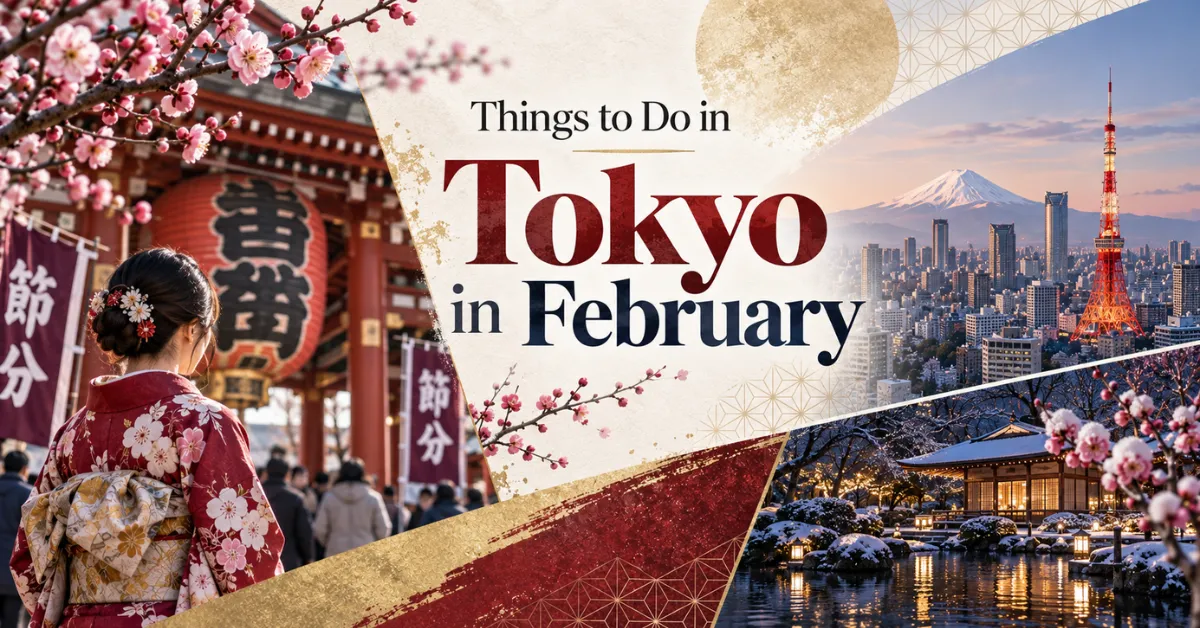
Tokyo in February runs on a short list of events that don’t repeat anywhere else on the calendar. Setsubun, the ritual marking the seasonal turn from winter to spring, fills temples and shrines with bean-throwing crowds around February 3, and it’s the single busiest day of the month.
Plum blossoms are the other anchor. Unlike cherry blossoms, which open in a tight, citywide window, plum trees bloom gradually from late January into March depending on the tree and the garden. That spreads the good viewing days out over several weeks instead of one, which is the main reason plum viewing rewards a flexible schedule more than a fixed date.
Valentine’s Day adds a narrower layer on top. Department stores run chocolate fairs and hotels run dessert buffets through the month, most of it aimed at gift shoppers and couples rather than sightseers.
The weather stays cold enough for a real coat, but February is typically one of Tokyo’s driest, clearest months, which makes outdoor plans like plum viewing or an evening illumination more dependable than they were in January. None of this replaces Tokyo’s usual sights. It just changes which ones are worth timing on purpose.
What Are the Best Things to Do in Tokyo in February?
The best things to do in Tokyo in February are listed below.
- Join Setsubun Celebrations at Zojoji Temple
- Watch the Setsubun Bean-Throwing Ceremony at Senso-ji Temple
- Celebrate Setsubun at Kanda Myojin
- Attend the Setsubun Festival at Okunitama Shrine
- Attend Hatsuuma-sai at Mabashi Inari Shrine
- Browse the Oji Inari Shrine Kite Market
- Admire Plum Blossoms at Yushima Tenmangu
- Visit the Setagaya Plum Blossom Festival at Hanegi Park
- Walk Among Plum Blossoms at Kyodo no Mori
- Enjoy Plum Blossoms at Koishikawa Korakuen
- See Rapeseed Flowers at Hama-rikyu Gardens
- Visit the Daffodil Festival at Kasai Rinkai Park
- Catch the Last Winter Peonies at Ueno Toshogu
- Enjoy Tokyo’s Late-Winter Illuminations
- See the Tokyo Dome City Winter Illumination
- Go Ice Skating in Tokyo
- Shop Tokyo’s Valentine’s Chocolate Fairs
- Try Strawberry Dessert Buffets and Afternoon Teas
- Watch the Ome Road Race
- Experience the Some no Komichi Dyeing Festival
- Warm Up at a Tokyo Onsen or Sento
- Take in Clear Winter Views from a Tokyo Observation Deck
- Eat Nabe, Oden, and Other Winter Comfort Foods
These split into a few real categories: Setsubun ceremonies, flower and garden viewing, evening illuminations, Valentine’s-season shopping and dining, one-off local events, and weather-proof standbys like onsens and comfort food. Bean-throwing ceremonies reward arriving early and tolerating a crowd. Flower viewing rewards flexibility, since bloom timing shifts by a week or two depending on the winter.
A few entries here, including the onsens, illuminations, and comfort food, also earn a spot among Tokyo’s broader things to do, useful well beyond February. Setsubun and plum viewing are the exceptions. They only make sense within this specific stretch of the calendar.
1. Join Setsubun Celebrations at Zojoji Temple
Zojoji Temple in Minato holds its Setsubun Tsuina Ceremony on February 3, one of the more accessible bean-throwing events for visitors staying near Tokyo Tower. The ceremony includes mochi pounding and an “Oni-Mondo,” a question-and-answer ritual performed by local preschool children before the main event.
| Quick fact | Details |
|---|---|
| Best for | first Setsubun experience, families |
| Time needed | 1 to 2 hours |
| Area | Minato (near Tokyo Tower) |
| Reservation needed | no |
| Best time | early afternoon, ahead of the bean-toss |
| Cost | free |
The bean-tossing itself features entertainers and invited guests throwing beans, sweets, and small prizes from a stage, a lighter version of the format used at Tokyo’s bigger Setsubun venues. Zojoji works well as a first Setsubun stop precisely because it’s smaller and easier to see from, without the multi-hour wait that builds at Senso-ji or Kanda Myojin.
The trade-off is scale. If you want the full spectacle with celebrities and sumo wrestlers, Zojoji is more modest than that. Arrive a little before the stage program starts, since the temple grounds fill in fast once the ceremony gets underway.
2. Watch the Setsubun Bean-Throwing Ceremony at Senso-ji Temple
Senso-ji Temple in Asakusa, holds Tokyo’s biggest Setsubun event, drawing crowds close to 100,000 people on February 3. The day opens with a procession of the toshiotoko, volunteer parishioners who lead the ritual, starting at the temple’s Denboin building.
| Quick fact | Details |
|---|---|
| Best for | first-time visitors, cultural festivals |
| Time needed | 2 to 3 hours |
| Area | Asakusa |
| Crowd level | very high |
| Best time | early afternoon for a spot near the stage |
| Cost | free |
The Seven Lucky Gods Dance runs from around 2:30pm on a special stage set up on the east side of the main hall. From 4pm, entertainers throw beans four separate times at roughly 20-minute intervals, with geisha from the Tokyo Asakusa Association taking part in the final round. Outside of Setsubun, this same temple draws steady crowds year-round for its main hall, five-story pagoda, and Kaminarimon Gate.
The scale is the whole point and the whole problem. Getting a clear view of the stage means claiming a spot well before 4pm, and the crowd only thins out once the last round finishes. If you want the ceremony without the density, Zojoji or Kanda Myojin fill the same role with less waiting.
3. Celebrate Setsubun at Kanda Myojin
Kanda Myojin, a Shinto shrine in Chiyoda with close to 1,300 years of history, runs one of the more theatrical Setsubun programs in the city. The shrine is traditionally considered the guardian of the northeast gate of Edo Castle, a direction long regarded as unlucky, and its Setsubun ritual plays directly off that history.
| Quick fact | Details |
|---|---|
| Best for | history, ritual detail |
| Time needed | 1 to 2 hours |
| Area | Chiyoda (Sotokanda) |
| Reservation needed | no |
| Best time | before the parade begins |
| Cost | free |
Before the bean-tossing, Shinto priests dressed as ancient warriors perform the Meigen-no-Gi, a ritual in which they mime shooting arrows toward the shrine’s northeast and southwest gates, nicknamed the Devil’s Gate and Rear Devil’s Gate. A parade follows with dancers playing red and blue demons alongside the deities Daikoku and Ebisu, scattering beans as they go.
What sets Kanda Myojin apart from Senso-ji’s version is narrative. The arrow ritual and demon parade give the ceremony a clear story, which makes it easier to follow if you don’t read Japanese and just want to understand what you’re watching. Plan to be in place before the parade starts, since the route through the shrine grounds is narrow and fills quickly once it begins.
4. Attend the Setsubun Festival at Okunitama Shrine
Okunitama Shrine in Fuchu, one of Tokyo’s five major shrines, holds a Setsubun bean-throwing that regularly brings out sumo wrestlers, TV personalities, and athletes dressed in traditional kamishimo attire. The festivities run through the afternoon of February 3, with a parade along the shrine’s main approach where beans are tossed to the crowd.
| Quick fact | Details |
|---|---|
| Best for | a Setsubun day trip, celebrity guests |
| Time needed | half a day including travel |
| Area | Fuchu, western Tokyo |
| Access | Fuchuhommachi Station (JR Nambu, Musashino Lines) |
| Best time | afternoon |
| Cost | free |
Visitors who catch a bean can pick up a fuku-masu, a small wooden box treated as a good-luck charm for the year. Because Okunitama sits well outside central Tokyo, the crowd skews more local than the Asakusa or Kanda events, and it’s a reasonable pick for anyone who wants the celebrity-guest version of Setsubun without the density at Senso-ji.
The catch is travel time. Fuchu is roughly 30 to 40 minutes from central Tokyo by train, so this only makes sense as a half-day plan on its own, not a quick add-on to a morning already booked elsewhere in the city.
5. Attend Hatsuuma-sai at Mabashi Inari Shrine
Mabashi Inari Shrine in Suginami, founded in the late Kamakura period, holds its Hatsuuma Taisai on the first Day of the Horse in February, the day traditionally marking Inari’s descent to earth. The ceremony centers on making red-and-white ceremonial mochi while a special song is sung.
| Quick fact | Details |
|---|---|
| Best for | a local, unscripted ritual |
| Time needed | 30 to 60 minutes |
| Area | Suginami (Asagaya) |
| Access | 10-minute walk from Asagaya Station |
| Best time | around 3pm, for the mochi distribution |
| Cost | free |
Mochi-making runs from about 10am to 10:40am. The finished rice cakes are handed out to visitors around 3pm, along with amazake, a mildly sweet fermented rice drink. The shrine’s Zuishinmon gate, carved with rising and descending dragons, is worth a slow look on the way in.
This is a small, neighborhood-scale event rather than a spectacle, which is exactly its appeal if Senso-ji’s crowds sound like the opposite of what you want. Time your visit around 3pm specifically. Arriving too early or too late means missing the one moment most visitors actually come for.
6. Browse the Oji Inari Shrine Kite Market
Oji Inari Shrine in Kita City holds Tokyo’s Tako-ichi, or Kite Market, on the Days of the Horse in February, a tradition dating back to the Edo period when kites were sold as charms against fire. Depending on the year, the market runs two or three times in the month, since the Day of the Horse can fall more than once.
| Quick fact | Details |
|---|---|
| Best for | local tradition, casual browsing |
| Time needed | 30 to 60 minutes |
| Area | Kita City (Oji) |
| Access | short walk from Oji Station |
| Best time | 10am to 6pm on any market date |
| Cost | free entry; kites sold separately |
Stalls line the approach to the shrine selling handmade kites shaped like yakko, a samurai’s attendant, alongside close to 100 food vendors. The kites themselves are marketed as hibuse-no-tako, fire-prevention charms bought as much for decoration as for flying.
The event pairs naturally with Setsubun for anyone building a day around Kita City’s quieter side of Tokyo. Check the specific market dates before heading out, since they shift year to year and don’t always fall on a weekend.
7. Admire Plum Blossoms at Yushima Tenmangu
Yushima Tenmangu, a shrine in Bunkyo dedicated to Tenjin, the god of learning, hosts one of Tokyo’s best-known plum festivals, the Ume Matsuri, running from early February to early March. The shrine grounds hold around 300 plum trees, most of them the fragrant white Shirokaga variety, with peak bloom typically falling mid-to-late February.
| Quick fact | Details |
|---|---|
| Best for | plum viewing with shrine culture |
| Time needed | 1 to 2 hours |
| Area | Bunkyo, near Ueno |
| Best season | early Feb to early March, peak mid-to-late Feb |
| Access | 2-minute walk from Yushima Station |
| Cost | free |
Weekends bring taiko drumming, outdoor tea ceremonies, and traditional dance, along with food stalls selling plum-flavored sweets and hot amazake. The shrine is also where students come to pray for exam success, and thousands of wooden ema wish plaques hang around the grounds year-round, a detail that gives the plum viewing here a different texture than a purely scenic garden.
Yushima earns its place at the top of a plum-viewing list because it combines the flowers with an active, living tradition rather than just a well-kept garden. Weekday mornings are noticeably calmer than weekend afternoons, when the performance schedule pulls in the biggest crowds.
8. Visit the Setagaya Plum Blossom Festival at Hanegi Park
Hanegi Park in Setagaya hosts the Setagaya Ume Matsuri, a month-long festival built around roughly 650 plum trees across 60 varieties planted on a small residential hillside. The festival runs from early February into early March, with the trees typically at their fullest around mid-February.
| Quick fact | Details |
|---|---|
| Best for | casual, neighborhood-scale plum viewing |
| Time needed | about 1 hour |
| Area | Setagaya (Umegaoka) |
| Access | 1 to 2 minutes from Umegaoka Station |
| Best time | weekday mornings for fewer crowds |
| Cost | free |
Weekend and holiday stalls sell plum-themed treats like madeleines and jelly, and mochi pounding or tea ceremonies pop up on the busier days. On a clear day, one spot in the park frames Mount Fuji behind the blossoms, a detail that isn’t obvious from the entrance and is worth asking a local vendor about.
What separates Hanegi from Yushima or Koishikawa Korakuen is scale and mood. This is a local park festival, not a formal garden or a major shrine, and it draws a correspondingly more relaxed, neighborhood crowd. It’s a good pick if you want plum blossoms without the performance schedule pulling focus.
9. Walk Among Plum Blossoms at Kyodo no Mori
Kyodo no Mori, an open-air folk history museum in Fuchu, holds one of Tokyo’s largest plum groves, with around 1,300 trees across some 120 varieties spread through its grounds. The plum season runs from early February through mid-March, with evening illuminations lighting the grove on a handful of dates in late February.
| Quick fact | Details |
|---|---|
| Best for | a plum-and-museum day trip |
| Time needed | 2 to 3 hours |
| Area | Fuchu, western Tokyo |
| Access | near Bubaigawara Station |
| Best time | daytime for the grove, evening for illumination dates |
| Cost | around 300 yen museum admission |
Beyond the plum trees, the site includes restored merchant houses, a former elementary school building, and a planetarium, so the visit functions as a half-day out rather than a single stop. The scale of the grove alone sets it apart from Hanegi Park’s smaller, casual setting, and its museum buildings give it a different character from Yushima Tenmangu’s shrine grounds.
The trade-off is the trip itself. Fuchu sits well outside central Tokyo, so this only makes sense if you’re either building a full day around western Tokyo or specifically chasing one of the larger plum groves rather than a quick city-center stop.
10. Enjoy Plum Blossoms at Koishikawa Korakuen
Koishikawa Korakuen in Bunkyo, one of Tokyo’s oldest Edo-period strolling gardens, holds a Plum Festival from early February to early March around its roughly 150 plum trees. The garden was built for the Mito branch of the Tokugawa family and now carries Japan’s top heritage designation as both a Special Place of Scenic Beauty and a Special Historic Site.
| Quick fact | Details |
|---|---|
| Best for | a formal Edo garden with plum blossoms |
| Time needed | 1 to 2 hours |
| Area | Bunkyo (near Iidabashi) |
| Best season | early Feb to early March |
| Access | short walk from Iidabashi Station |
| Cost | 300 yen adults |
During the festival, the garden adds cultural performances, guided tours, and food trucks to its usual strolling paths, ponds, and stone bridges. Only one other garden in Tokyo, Hama-rikyu, shares Koishikawa Korakuen’s heritage designation, and the two make a natural comparison for anyone weighing which formal Edo garden to prioritize.
Koishikawa Korakuen is also well known for autumn foliage, so the plum season gives it a very different look from its more famous November crowds. Weekday visits are noticeably quieter, since the garden’s compact size means weekend festival crowds fill its paths fast.
11. See Rapeseed Flowers at Hama-rikyu Gardens
Hama-rikyu Gardens, a 62-acre former Tokugawa shogunate villa on the edge of Tsukiji and Shiodome, turns its central field into roughly 300,000 blooming rapeseed flowers from late February through mid-March. The garden also holds plum blossoms from late January into mid-March, so both flowers overlap for part of February.
| Quick fact | Details |
|---|---|
| Best for | skyline contrast, photography |
| Time needed | 1 to 1.5 hours |
| Area | Chuo and Minato (Shiodome) |
| Best season | rapeseed from late Feb, plum from late Jan |
| Access | short walk from Shiodome Station |
| Cost | small garden admission |
The garden’s tidal pond is the only one of its kind left in Tokyo, its water level shifting with the actual tide from Tokyo Bay, and a floating teahouse on the pond serves matcha to visitors who want to sit down for a while. The golden rapeseed field against Shiodome’s glass towers is one of the more striking early-spring photo spots in the city, precisely because the contrast between garden and skyline is so direct.
Late February is the safer bet if rapeseed is the priority, since the field is still building toward full bloom earlier in the month. If plum blossoms matter more than rapeseed on your visit, go earlier in February instead, while both are in a lighter, overlapping bloom.
12. Visit the Daffodil Festival at Kasai Rinkai Park
Kasai Rinkai Park in Edogawa runs its Suisen Matsuri, or Daffodil Festival, on a specific weekend in early February, with tens of thousands of daffodil bulbs planted in a field beneath the park’s giant Ferris wheel. A longer illumination event, the Flower and Light Movement, extends the daffodils’ evening display from late January through late February.
| Quick fact | Details |
|---|---|
| Best for | families, bay and Fuji views |
| Time needed | 1 to 2 hours |
| Area | Edogawa (Kasai) |
| Best time | the festival weekend, or evenings for illumination |
| Access | 1-minute walk from Kasai Rinkai-koen Station |
| Cost | free (facility fees apply separately) |
On the festival weekend, local towns known for daffodil growing sell regional specialties, and the park adds pony rides, street performances, and guided bird walks around its aviary. The flower field sits with clear views of Tokyo Bay and, on a good day, Mount Fuji in the distance, a combination that’s hard to find at any other flower spot on this list.
The festival weekend itself is the busiest single day, so anyone who wants the flowers without the crowd is better off visiting on a different day within the longer illumination window, when the daffodils are still blooming but the stalls and pony rides aren’t running.
13. Catch the Last Winter Peonies at Ueno Toshogu
Ueno Toshogu’s Botan Garden, next to the 1627 shrine dedicated to Tokugawa Ieyasu, is the only place in Tokyo where peonies bloom in winter. The Winter Peony Festival runs from January 1 through roughly the third week of February, so by the time this list is relevant, the display is already winding down.
| Quick fact | Details |
|---|---|
| Best for | a quick, off-season flower stop |
| Time needed | 30 to 45 minutes |
| Area | Taito (Ueno Park) |
| Best time | before the season ends, typically around Feb 20 |
| Access | Ueno Station, Koen-guchi exit |
| Cost | around 700 yen adults |
Around 150 winter peony plants sit under individual straw hoods that protect them from frost, a technique that delays a spring-blooming variety by roughly eight months so it flowers in the cold instead. Seeing them against the shrine’s five-story pagoda and Edo-period lantern rows gives the display a setting that a standalone flower show wouldn’t have.
Because the season closes in mid-to-late February, this is one of the few entries on this list with a real deadline attached. Confirm the closing date before planning a trip specifically around it, since it can shift by a few days year to year.
14. Enjoy Tokyo’s Late-Winter Illuminations
Many of Tokyo’s winter illumination displays, lit since November, are still running through February before they shut down for spring, which makes late winter a good window to catch one without the December crowds. Roppongi Hills, Yebisu Garden Place, and several shopping and hotel complexes keep their light displays up into late February, alongside the larger Tokyo Dome City show covered separately below.
| Quick fact | Details |
|---|---|
| Best for | evening plans, couples, photography |
| Time needed | 1 hour or more |
| Area | multiple, citywide |
| Best time | after sunset, around 5 to 7pm |
| Cost | mostly free to view |
Most of these displays close out their season by the end of February or the first days of March, so late-winter visitors get a last chance at lights that have already been running for two or three months elsewhere in the city. The atmosphere by this point tends to be calmer than the opening weeks in November, since the initial rush of visitors has already passed.
The practical issue is timing against closures. A few venues wind down mid-month rather than at month’s end, so it’s worth checking a specific complex’s dates before building an evening around it rather than assuming every illumination in the city runs the full month.
15. See the Tokyo Dome City Winter Illumination
Tokyo Dome City’s Winter Illumination, running from mid-November through late February or early March, is one of the largest light displays in the city, built around roughly one million LEDs under a “Snow Dome” theme. The show lights up nightly from 5pm to midnight and is free to walk through.
| Quick fact | Details |
|---|---|
| Best for | date nights, photography |
| Time needed | 1 to 2 hours |
| Area | Bunkyo (Suidobashi, Korakuen) |
| Hours | 5pm to midnight |
| Access | Suidobashi or Korakuen Station |
| Cost | free to view; rides and facilities cost extra |
The centerpiece is a 15-meter Wonder Snow Tree at the Crystal Avenue lawn plaza, wrapped in around 250,000 LEDs, with a light-and-bubble show that repeats every 15 minutes. A separate Snowflake Dome inside LaQua Garden lets visitors design their own light pattern on a tablet, and a Sparkle Tunnel runs beneath the Thunder Dolphin roller coaster.
What makes this display worth naming separately from the citywide illumination roundup above is scale and staying power. It’s one of the few winter light shows that runs essentially the entire season without an early shutdown, so it’s a safer bet on a trip planned late in February than most other displays.
16. Go Ice Skating in Tokyo
Several of Tokyo’s seasonal outdoor rinks stay open through most or all of February before closing for spring, including Tokyo Midtown’s rink in Roppongi and the Yebisu Garden Place rink near Ebisu Station. Admission plus skate rental typically runs in the low thousands of yen depending on the venue.
| Quick fact | Details |
|---|---|
| Best for | families, casual winter activity, date nights |
| Time needed | 1.5 to 2 hours |
| Area | multiple, citywide |
| Indoor/outdoor | mostly outdoor, seasonal |
| Reservation needed | not usually |
| Cost | admission plus rental, varies by venue |
Tokyo Midtown’s rink is the largest of the outdoor options and stays lively through the day before shifting to a lit, more atmospheric scene after sunset against the Roppongi skyline. Yebisu Garden Place uses artificial ice rather than real ice, which keeps it running regardless of temperature swings, and pairs its rink with a winter light show on the same site.
Most of these rinks close by late February or the first days of March, so this is close to the last reliable month to skate outdoors in Tokyo before the season ends. Bring warmer layers than you’d expect. Standing rinkside between skating turns is colder than the activity itself.
17. Shop Tokyo’s Valentine’s Chocolate Fairs
Tokyo’s major department stores turn into a genuine chocolate destination every January and February, led by Isetan Shinjuku’s Salon du Chocolat, which brings in over 150 brands from Japan and abroad, and Takashimaya’s Amour du Chocolat, which typically runs from late January through Valentine’s Day itself. Most fairs open in mid-January and close around February 14 to 15.
| Quick fact | Details |
|---|---|
| Best for | gift shopping, chocolate lovers, couples |
| Time needed | 1 to 2 hours |
| Area | department stores citywide |
| Best time | weekday mornings |
| Reservation needed | sometimes, for the busiest venues |
| Cost | purchase-based |
These fairs sit on top of Japan’s specific Valentine’s custom, where women have traditionally given chocolate to men, including small “giri-choco” gifts for coworkers, with men reciprocating on White Day in March. In recent years, self-purchased “self-reward” chocolate has become a bigger share of sales than gift-giving, which shows up in the fairs as much floor space for personal indulgence as for gift boxes.
The first day, last day, and every weekend of a fair are reliably the most crowded, sometimes requiring a numbered entry ticket at Isetan’s event specifically. If a particular chocolatier’s stock matters to you, weekday mornings are the difference between browsing calmly and finding a sold-out table.
18. Try Strawberry Dessert Buffets and Afternoon Teas
Tokyo hotels run seasonal strawberry dessert buffets and themed afternoon teas through the winter and into spring, with February landing near the middle of that stretch when strawberries are at their sweetest. These are ticketed, time-limited seatings rather than walk-in dining.
| Quick fact | Details |
|---|---|
| Best for | dessert lovers, group outings, couples |
| Time needed | 1.5 to 2 hours |
| Area | hotels citywide |
| Reservation needed | yes, often weeks ahead |
| Best time | weekday seatings for better availability |
| Cost | buffet-priced, varies by hotel |
Menus typically build entirely around one strawberry variety for the season, with tarts, parfaits, and drinks rotating through a single seating slot of 90 minutes to two hours. Because these run inside hotel restaurants rather than open floors, the room and seating are usually more comfortable than a department store food event, at the cost of needing a reservation well in advance.
Weekend slots at well-known hotels can book out a month or more ahead during peak strawberry season, so this is one of the few entries on this list that rewards planning before you land in Tokyo rather than deciding on the day.
19. Watch the Ome Road Race
The Ome Road Race, formally the Ohme 30km and 10km Road Race, is one of Japan’s oldest citizen marathons, running since 1967 through the western Tokyo city of Ome each mid-February. Thousands of runners take part, from serious competitors to costumed amateurs and retirees in their 70s.
| Quick fact | Details |
|---|---|
| Best for | spectator sports, an offbeat local event |
| Time needed | half a day |
| Area | Ome City, western Tokyo |
| Best time | race morning, mid-February |
| Access | near Kabe Station, JR Ome Line |
| Cost | free to watch |
The course runs through Ome’s older townscapes and surrounding nature, giving spectators a very different backdrop from the city-center races Tokyo is better known for. Locals line the route in numbers, and the race has attracted former Olympic-level runners as guest starters in past editions, which gives it a bit more prestige than a typical local fun run.
This only works as a plan if the race date fits your trip, since it happens on one specific morning rather than across a season. If you’re not building a day around it, it’s easy to skip. If you are, arriving at the course early secures a spot to actually see the runners pass rather than a view of someone else’s back.
20. Experience the Some no Komichi Dyeing Festival
The Some no Komichi Dyeing Festival takes over the Nakai and Ochiai neighborhoods of Shinjuku for a three-day weekend, usually the last or third weekend of February, celebrating the area’s history as one of Tokyo’s major kimono-dyeing districts. Long strips of freshly dyed cloth are hung above the Myoshoji River for roughly 300 meters.
| Quick fact | Details |
|---|---|
| Best for | textile and craft lovers, quiet neighborhoods |
| Time needed | 1 to 1.5 hours |
| Area | Shinjuku (Nakai, Ochiai) |
| Access | Nakai Station, Seibu Shinjuku Line or Toei Oedo Line |
| Best time | daytime, any day of the three-day run |
| Cost | free |
Until the 1950s, local dyers actually used the river to rinse freshly dyed fabric before hanging it to dry, and the festival revives that image on purpose, with more than 100 businesses in the area displaying custom noren curtains to mark their participation. Some visitors come in kimono, and an information desk near the station hands out a free festival map with brief English notes.
This is a genuinely local, low-key event compared to almost everything else on this list, which is its main appeal. It rewards visitors who want to see a residential side of Tokyo rather than another temple or department store, but it only runs on its one weekend, so it needs to be checked against a trip’s actual dates.
21. Warm Up at a Tokyo Onsen or Sento
Cold February evenings are a good excuse to try either a sento, a neighborhood public bathhouse using regular tap water, or an onsen, a hot spring facility, and Tokyo has both in quantity. Sento prices are set by the Tokyo metropolitan government at a fixed rate, currently 550 yen for adults, the same at nearly every bathhouse in the city.
| Quick fact | Details |
|---|---|
| Best for | relaxation, cold-weather comfort |
| Time needed | 1 to 2 hours |
| Area | citywide |
| Cost | sento around 550 yen; onsen resorts higher |
| Tattoo policy | varies, check individual facilities |
| Best time | early evening, before the after-work rush |
Sento are smaller, cheaper, and closer to daily life, some housed in older buildings with traditional miyazukuri architecture and hand-painted Mount Fuji murals on the wall. Onsen, by contrast, use natural spring water and are often bigger, destination-style facilities with higher admission, sometimes an hour or more outside the city center.
Sento work well as a quick, cheap, genuinely local evening activity slotted into an otherwise packed day. A proper onsen day trip is a bigger commitment and better suited to a day with no other plans attached, since travel and bathing time together can fill most of an afternoon.
22. Take in Clear Winter Views from a Tokyo Observation Deck
Winter’s lower humidity gives Tokyo’s observation decks some of their clearest sightlines of the year, and February keeps that advantage right up until spring haze starts to build. Tokyo Skytree and Tokyo Tower are the two most established options, each offering a different angle on the same winter clarity.
| Quick fact | Details |
|---|---|
| Best for | city views, photography, first-time visitors |
| Time needed | 1 to 2 hours |
| Area | Sumida (Skytree), Minato (Tokyo Tower) |
| Reservation needed | recommended for sunset slots |
| Weather dependence | high, visibility varies day to day |
| Cost | admission fee, varies by deck |
On a genuinely clear winter day, Mount Fuji is visible from both towers, something that’s far less reliable in summer’s humidity. Tokyo’s red-and-white tower gives a lower, more central view over Minato and Tokyo Bay, while Skytree’s greater height covers a wider stretch of the city, including the Sumida River and Tokyo’s eastern neighborhoods.
The trade-off between the two decks comes down to timing more than location. Sunset slots book up fastest and sell out first at both towers in winter, since the combination of an early sunset and clear skies is exactly what makes February one of the better months to go up.
23. Eat Nabe, Oden, and Other Winter Comfort Foods
Nabe, a category of hot pot dishes cooked and shared at the table, and oden, a simmered assortment of fish cakes, daikon, eggs, and other ingredients in a light dashi broth, are both at their peak popularity in Tokyo through February. Convenience stores sell oden by the piece from heated counters, while dedicated nabe restaurants serve full pots designed for two or more people to share.
| Quick fact | Details |
|---|---|
| Best for | cold-weather comfort, group dining |
| Time needed | 1 to 1.5 hours for a sit-down meal |
| Area | citywide |
| Best for groups | yes, nabe is shared by design |
| Cost level | low to moderate |
| Best time | dinner, or oden any time from a convenience store |
Nabe comes in regional variations, from Kanto-style sukiyaki to Hokkaido-style seafood pots, and most restaurants let a table build a custom pot from a set ingredient list rather than a fixed menu. Oden’s convenience-store version is genuinely casual, a handful of skewered items picked up on the way somewhere else rather than a sit-down meal.
The two dishes solve different problems. Oden is the fastest, cheapest way to warm up mid-errand, while nabe is a proper dinner built around sitting still at a table for a while. On a genuinely cold February evening, a shared nabe pot is one of the more reliable ways to end a day of temple visits and flower viewing without needing much English to order it.
What Is the Weather in Tokyo in February?
Tokyo in February stays cold enough for a real winter coat, but it’s typically one of the city’s driest and clearest months, which is part of why so much of this month’s calendar happens outdoors.
What Is the Temperature of Tokyo in February?
Average daytime highs run around 10 to 11°C (50 to 51°F), with overnight lows typically dropping to 1 to 3°C (34 to 37°F). Daily swings of 8 to 10°C between afternoon and night are common, so a mild-feeling early afternoon can still turn sharply cold once the sun goes down.
Does It Snow in Tokyo in February?
Tokyo sees only a handful of snow days most winters, and February usually brings fewer than January, since the coldest, snowiest stretch of the season tends to fall slightly earlier. Travelers weighing the two months should note this when comparing a Tokyo trip in January against February.
Will It Be Snowing in Tokyo in February?
Most days in February pass with no snow at all, and when it does fall, it’s usually light flurries rather than accumulation. Central Tokyo rarely holds snow on the ground for more than a day, though a stronger system can occasionally bring a heavier, short-lived snowfall that briefly disrupts trains and flights.
What Is the Weather in Tokyo at the End of February?
Late February starts to feel noticeably less bleak than early in the month, with with slightly longer days and the first plum blossoms in bloom. Cherry blossoms haven’t started yet, but late February is when travelers planning a March trip to Tokyo start watching bloom forecasts.
Is Tokyo Good to Visit in February?
February works well for travelers who want lower prices, thinner crowds at major sights, and a specific set of seasonal events that only happen this month, provided the cold weather itself isn’t a dealbreaker.
What Are the Advantages of Visiting Tokyo in February?
Hotel rates and flight prices sit closer to their annual low point, since February falls between the New Year travel season and the cherry blossom rush in late March and April.
Major attractions run noticeably thinner crowds than in spring or autumn, and this month’s specific events, Setsubun, plum blossoms, and the tail end of winter illuminations, don’t happen on the same schedule any other time of year. Travelers comparing Tokyo’s seasons in the basics of visiting Tokyo guide will find February holds up well specifically on cost and crowd levels.
Are There Any Downsides to Visiting Tokyo in February?
The obvious one is the cold, which rules out some warm-weather activities and means more time indoors than a spring or summer trip. Days are also shorter than later in the year, which compresses the usable daylight window for outdoor sightseeing and pushes evening plans, like illuminations, earlier than a summer visitor might expect.
Is Early or Late February Better for Visiting Tokyo?
Early February is the better window for Setsubun, since the ceremonies cluster around February 3 and don’t repeat later in the month. Late February suits plum blossoms better at most gardens, along with the last chance at winter peonies and the closing weeks of several ice rinks and illuminations before they shut down for spring.
What Should You Wear in Tokyo in February?
Layering is the main strategy, since indoor spaces in Tokyo run warm while the outside air stays close to freezing overnight.
Do You Need a Winter Coat in Tokyo in February?
Yes. A proper insulated coat, not just a light jacket, is worth packing given overnight lows regularly near freezing and daytime highs that only reach the low teens Celsius at best. A scarf and gloves add real comfort for early morning temple visits or standing outside for an illumination.
What Should You Pack for Tokyo in February?
Warm layers that peel off easily matter more than any single heavy item, since heated trains, shops, and restaurants run significantly warmer than the street outside. Comfortable, weatherproof walking shoes are worth prioritizing over fashion boots, especially for temple visits where paths can be uneven or occasionally icy after a cold night.
How Crowded Is Tokyo in February?
Overall, February is one of the calmer months on Tokyo’s tourism calendar, with a few sharp exceptions tied to specific dates.
Is February a Busy Tourist Season in Tokyo?
No, not by Tokyo’s standards. The month sits well below the crowd levels of cherry blossom season in late March and April or the autumn foliage rush in November, which is part of why hotel prices trend lower.
Are Tokyo Attractions Crowded in February?
Most attractions run noticeably thinner than in peak season, with shorter lines at major sights and more breathing room at gardens and observation decks. The clear exceptions are Setsubun venues on February 3 and popular plum gardens on a sunny weekend during peak bloom, both of which can feel just as packed as any high season crowd.
Are Weekends and February Events More Crowded?
Yes, consistently. Weekend and holiday visits to plum festivals, chocolate fairs, and illuminations draw noticeably more people than the same spot on a weekday, and Setsubun ceremonies are dense regardless of the day of the week they fall on, since the date itself is fixed.
How Should You Plan a Tokyo Trip in February?
February rewards a loosely structured plan more than a tightly scheduled one, since several of the month’s best activities depend on weather and bloom timing that can’t be locked down months ahead.
How Many Days Do You Need in Tokyo in February?
Four to five days is enough to cover a mix of Setsubun events, one or two plum gardens, an illumination, and the city’s usual sights without rushing. Travelers sketching out a day-by-day plan for Tokyo should build in at least one flexible day for weather or bloom timing rather than fixing every activity to a specific date in advance.
Should You Plan February Activities Around the Weather?
For the outdoor entries on this list, yes. Plum viewing, illuminations, and observation deck visits all depend on clear skies more than the indoor events do, so it’s worth checking the forecast a day or two out and keeping a rainy-day alternative, like a museum, an onsen, or a shopping arcade, in reserve.
Which February Activities Need to Be Planned in Advance?
Strawberry dessert buffets need reservations that are often made weeks ahead, and observation deck sunset slots and the busiest chocolate fair days can sell out too. Setsubun ceremonies and most plum gardens don’t need advance booking, since they’re open events rather than ticketed seatings, but arriving early still matters for a decent spot.
What Should You Do If It Rains or Snows in Tokyo?
Shift the day toward indoor options: a museum, an aquarium, a shopping complex, or a sento, all of which work just as well in bad weather as good. A private guide can also rearrange a day’s plan around rain or cold more easily than a fixed group tour can, which is worth factoring in if you’re weighing a Tokyo private tour against a self-guided schedule for a February trip.
