
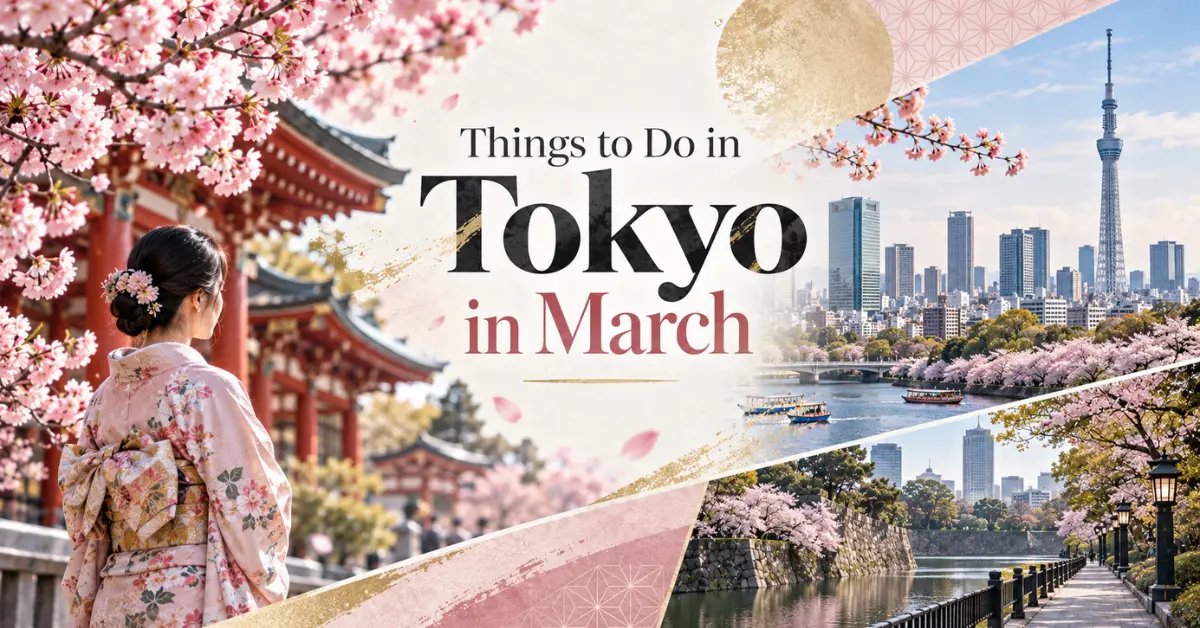
March in Tokyo covers two different trips depending on which week you land in. Early March still feels like winter, with bare branches, cold mornings, and a calendar built around plum blossoms, temple festivals, and the Tokyo Marathon rather than sakura. Late March is where the season turns, as the city’s official cherry tree usually opens and parks and riverbanks start filling with hanami crowds.
That timing gap is the main thing to plan around. Cherry blossom dates shift by a week or more depending on the year’s weather, so a trip booked for full bloom can just as easily land before the flowers open or after the crowds have thinned.
March’s festival calendar sits on top of the sightseeing that Tokyo keeps running all year, the kind already covered in the main Tokyo things to do list, so a first visit does not have to be timed around cherry blossoms alone. Jindaiji Temple’s daruma doll fair, Mt. Takao’s fire-walking ceremony, and Senso-ji’s Golden Dragon Dance all run on fixed dates that have nothing to do with the weather.
Because outdoor plans can be disrupted by a late cold spell or an early bloom, it helps to mix confirmed-date festivals with flexible sakura viewing, rather than building the whole trip around one weekend of blossoms.
What Are the Best Things to Do in Tokyo in March?
The best things to do in Tokyo in March are listed below.
- Celebrate Hina Matsuri, Japan’s Doll Festival
- Visit the Jindaiji Temple Daruma Doll Fair
- Watch the Tokyo Marathon
- See Late Plum Blossoms at Yushima Tenmangu
- Visit the Ome Plum Blossom Festival
- See the Plum Blossoms at Takao Baigo
- Watch the Mt. Takao Fire-Walking Festival
- Hike Mt. Takao in Early Spring
- See the Kinryu-no-Mai Golden Dragon Dance at Senso-ji
- See Rapeseed Flowers at Hama-rikyu Gardens
- Visit the Showa Kinen Park Flower Festival
- Experience Tokyo Creative Salon
- See Tokyo’s First Cherry Blossoms of the Year
- Have Hanami at Shinjuku Gyoen
- Experience the Ueno Sakura Matsuri
- See Cherry Blossoms Along the Sumida River
- Take a Sakura Cruise on the Sumida River
- Walk Beneath the Cherry Blossoms at Chidorigafuchi
- Row a Boat Beneath the Sakura at Chidorigafuchi
- See Chidorigafuchi’s Cherry Blossoms at Night
- Walk Beneath the Cherry Blossoms Along the Meguro River
- See Rikugien’s Weeping Cherry Tree Illuminated at Night
- Visit the Koganei Cherry Blossom Festival
- See the Cherry Blossoms at Toneri Park
- Experience the Gotenyama Sakura Festival
- Attend AnimeJapan at Tokyo Big Sight
- Try Sakura-Themed Food and Drinks
- Have a Spring Picnic in Yoyogi Park or Inokashira Park
These range from single-day festivals with a fixed date to sakura spots that only make sense once the flowers are actually open. Roughly the first half of the list runs regardless of weather or bloom status, while everything from the first cherry blossoms onward depends on a forecast that moves every year. The right mix for your trip depends on which half of March you’re visiting, whether you want crowds and atmosphere or a quieter spot, and how much you’re willing to build a day around something that might get pushed back a week.
1. Celebrate Hina Matsuri, Japan’s Doll Festival
Hina Matsuri, also called the Doll Festival, falls on March 3 and marks a national day honoring young girls with tiered displays of ornamental hina dolls. Most families keep their own display at home, but Tokyo puts up large public versions at shrines, department stores, and cultural centers through the first week of March, and these stay open to visitors without any reservation.
| Quick fact | Details |
|---|---|
| Best for | culture, families, photography |
| Time needed | 30 to 60 minutes per display |
| Area | citywide, concentrated at shrines and department stores |
| Best time | late February through March 3 |
| Cost level | free at most public displays |
Public displays are the easiest way to see Hina Matsuri without an invitation into someone’s home, since the custom is mainly private. Shrines and several major department stores set up arrangements running to a hundred dolls or more stacked on red-carpeted steps, and they welcome walk-in visitors during normal opening hours.
Parents traveling with young daughters often build a morning around one of these displays, since it pairs naturally with other family-friendly stops around Tokyo that same week. The dolls come down right after March 3, so anyone arriving later in the month will not see them and should not expect the festival to overlap with cherry blossom season.
2. Visit the Jindaiji Temple Daruma Doll Fair
The Jindaiji Temple Daruma Doll Fair is a fixed-date market held every March 3 and 4 at Jindaiji, one of the oldest temples in the Kanto region, in Chofu City on Tokyo’s western edge. It runs alongside the temple’s biggest yearly ritual, so the grounds are busiest and most atmospheric on those exact two days.
| Quick fact | Details |
|---|---|
| Best for | culture, first-timers wanting something non-touristy |
| Time needed | 1 to 2 hours |
| Area | Chofu, western Tokyo |
| Best time | March 3 to 4 only |
| Cost level | free to enter, daruma dolls sold separately |
Around 300 stalls fill the temple approach and grounds selling daruma dolls in every size, and the fair is considered one of Japan’s three major daruma markets. After buying one, visitors can have a monk paint in its left eye at a dedicated booth, a small ritual tied to making a wish that the doll’s owner completes later by filling in the right eye once the wish comes true.
The event is worth the trip mainly because it has nothing to do with cherry blossoms, so it holds up even in a year when the bloom runs late. Since the fair only runs these two days, anyone arriving on March 5 or later will find a quiet temple with no market at all.
3. Watch the Tokyo Marathon
The Tokyo Marathon is one of the World Marathon Majors and runs every year on a Sunday in early March, sending tens of thousands of runners through the city center from Shinjuku to a finish near Tokyo Station. Spectators don’t need a ticket, just a spot along the route.
| Quick fact | Details |
|---|---|
| Best for | spectators, runners, city views |
| Time needed | half a day if watching |
| Area | route crosses Shinjuku, Ginza, Asakusa, and Marunouchi |
| Best time | one fixed Sunday in early March |
| Cost level | free to watch |
The course passes several landmarks travelers already plan to see, including stretches near Tokyo Tower and through Asakusa, which makes it easy to catch the runners without rerouting a whole day. Crowds gather several rows deep at the start and finish areas, but a spot along a quieter stretch of the route gives a closer view with far less shoving.
The trade-off is transportation. Large sections of central Tokyo close to traffic for most of the morning, so anyone not specifically watching the race should check the route map and plan around the road closures rather than through them.
4. See Late Plum Blossoms at Yushima Tenmangu
Yushima Tenmangu, a shrine in Bunkyo known for its roughly 300 plum trees, holds its main plum festival from early February into the first week of March, which makes early March the last realistic window to catch the blossoms before they’re gone.
| Quick fact | Details |
|---|---|
| Best for | quiet sightseeing, plum blossoms, students |
| Time needed | 30 to 45 minutes |
| Area | Yushima, Bunkyo |
| Best time | late February to the first week of March |
| Cost level | free |
The shrine’s white-blossomed Shirokaga plums usually peak in the second half of February, so a visit in the first days of March catches the tail end rather than the best of the display. Yushima Tenmangu is also dedicated to the deity of learning, which means it draws visiting students alongside the flower crowd, a mix that gives the shrine a slightly different atmosphere than a purely scenic plum garden.
Since the blossoms fade quickly once they pass peak, anyone specifically chasing plum flowers should treat this as a first-week-of-March stop only, not a fallback for later in the month.
5. Visit the Ome Plum Blossom Festival
The Ome Plum Blossom Festival is a one-day event held on a Sunday in early March at Yoshino Baigo, a plum-growing area in western Tokyo that was once one of the city’s best-known blossom destinations.
| Quick fact | Details |
|---|---|
| Best for | plum blossoms, local festival atmosphere |
| Time needed | 2 to 3 hours |
| Area | Ome, western Tokyo |
| Best time | one Sunday in early March |
| Cost level | free, food and stalls cost extra |
The festival includes a samurai-costume parade, traditional hayashi music, and lion dances, alongside food stalls lining the road near Hinatawada Station. Yoshino Baigo’s grove is smaller than it used to be, since a plant disease wiped out most of the original trees and the area has spent years regrowing what was lost, so the display here reads as recovering rather than mature.
That makes Ome a better fit for the festival atmosphere and the samurai parade than for the plum blossoms themselves, since Takao Baigo or Yushima Tenmangu still offer denser blossom viewing on a day without an event.
6. See the Plum Blossoms at Takao Baigo
Takao Baigo refers to a string of plum groves running along the old Koshu highway near the foot of Mt. Takao, roughly 10,000 trees spread across eight separate groves.
| Quick fact | Details |
|---|---|
| Best for | plum blossoms, combining with a Mt. Takao visit |
| Time needed | 1 to 2 hours |
| Area | foot of Mt. Takao, western Tokyo |
| Best time | early to mid-March |
| Cost level | free |
Most groves are visible from the walking path year round, but two of them, including one holding around 1,400 trees, open specially to the public for roughly two weeks around the mid-March festival. The scale here is the main draw: eight distinct groves along a walkable riverside path give a longer, less crowded plum experience than a single shrine garden.
Because Takao Baigo sits right at the trailhead, it pairs naturally with a same-day hike or the fire-walking festival held nearby, so it rarely needs to be a stop on its own.
7. Watch the Mt. Takao Fire-Walking Festival
The Mt. Takao Fire-Walking Festival, or Hiwatari-sai, is held every year on the second Sunday of March at the foot of the mountain, organized by the Yakuo-in temple that sits partway up the slope.
| Quick fact | Details |
|---|---|
| Best for | culture, a unique one-day event |
| Time needed | 2 to 3 hours |
| Area | foot of Mt. Takao, near Takaosanguchi Station |
| Best time | second Sunday of March, from around 1pm |
| Cost level | free |
Robed monks lead a long ritual of chanting, archery, and prayer before building a large fire and walking barefoot across the resulting embers, a practice tied to Shugendo mountain asceticism. Once the embers cool enough, members of the public are invited to walk across as well, a detail that turns the event from a spectator ritual into something visitors can actually take part in.
Arriving close to the 1pm start gives the best view of the full ceremony, since the crowd thickens fast once the fire itself is lit and most people only see the walking part if they arrive late.
8. Hike Mt. Takao in Early Spring
Mt. Takao, about an hour from central Tokyo by train, is one of the most accessible mountains near the city, with a paved main trail, several rougher hiking routes, and a cable car and chairlift for anyone who doesn’t want to walk the whole way.
| Quick fact | Details |
|---|---|
| Best for | hikers, day-trippers, views |
| Time needed | half a day |
| Area | Hachioji, western Tokyo |
| Best time | any clear day in March |
| Cost level | free trail access, cable car and chairlift cost extra |
Early spring puts the plum groves at the base in bloom while the summit itself stays cool enough to hike comfortably, and on a clear day the view from the top can reach as far as Mt. Fuji. The trail network ranges from the paved Trail 1, manageable in normal shoes, to steeper, quieter routes for anyone who wants to skip the crowds around the main path.
March draws far fewer hikers than the autumn foliage season, so a weekday visit can feel almost empty even though the mountain sits well within Tokyo’s transit network. Combining the hike with the plum groves or the fire-walking festival turns a single train ride into a full day rather than a quick round trip.
9. See the Kinryu-no-Mai Golden Dragon Dance at Senso-ji
Kinryu-no-Mai, the Golden Dragon Dance, is performed every March 18 at Senso-ji, Tokyo’s oldest temple, commemorating a legend about a golden dragon that appeared when the temple was founded.
| Quick fact | Details |
|---|---|
| Best for | culture, photography, first-time Asakusa visitors |
| Time needed | 1 to 2 hours |
| Area | Asakusa |
| Best time | March 18 only, performed two to three times that day |
| Cost level | free |
An 18-meter dragon puppet, operated by eight dancers and led by a ninth carrying a lotus flower, winds its way down Nakamise Shopping Street toward Tokyo’s oldest temple as drums and geisha performers accompany the procession. The dance runs two or three times over the course of the day, and each performance draws a real crowd along the narrow shopping street.
Arriving before noon secures a decent view without fighting the thickest crowds, since the later afternoon performance tends to pull the biggest audience. Outside March 18 and its October counterpart, the dance doesn’t happen at all, so this is one entry on the list that only works on one specific date.
10. See Rapeseed Flowers at Hama-rikyu Gardens
Hama-rikyu Gardens, a former Edo-period retreat for the ruling shogun family near Shiodome, fills a wide field with bright yellow rapeseed, or nanohana, from late February through March.
| Quick fact | Details |
|---|---|
| Best for | photography, a quiet break from sightseeing |
| Time needed | 45 minutes to 1 hour |
| Area | Shiodome |
| Best time | late February to March |
| Cost level | ticketed, modest fee |
The field’s yellow color stands out against the Shiodome skyscrapers directly behind it, a contrast between old garden and modern skyline that photographs well and needs no cherry blossoms to work. The garden also keeps a tidal pond and an island teahouse, both features from its original design, giving visitors more to see than just the flower field itself.
Because nanohana peaks earlier than sakura, this is a solid stop for a trip in the first half of March, when most cherry trees are still bare and there’s otherwise little flower color to see outdoors.
11. Visit the Showa Kinen Park Flower Festival
Showa Kinen Park in Tachikawa runs a multi-month Flower Festival that opens in mid to late March with fields of nanohana and, depending on the year, early cherry blossoms, before shifting to tulips in April.
| Quick fact | Details |
|---|---|
| Best for | families, a full day outdoors, flower fields |
| Time needed | half a day |
| Area | Tachikawa, western Tokyo |
| Best time | mid to late March for nanohana and early sakura |
| Cost level | ticketed, modest fee |
The park itself is one of the largest in the Tokyo area, with wide lawns, cycling paths, and bike rental alongside the flower gardens, so the festival works as an outing rather than a single photo stop. In March specifically, the nanohana fields are the highlight, since the tulip displays that get most of the festival’s attention don’t open until April.
The trade-off is distance: Tachikawa sits roughly 30 to 50 minutes from central Tokyo, which makes this a better fit for a day with no other fixed plans than a quick add-on between other stops.
12. Experience Tokyo Creative Salon
Tokyo Creative Salon is an annual citywide festival of fashion, design, and art held for about ten days in mid-March, spreading free programs across several central districts, including Ginza, that shift year to year.
| Quick fact | Details |
|---|---|
| Best for | design and fashion fans, city exploring |
| Time needed | 1 to 3 hours depending on how many areas |
| Area | multiple central districts, commonly Ginza |
| Best time | mid-March, roughly a ten-day run |
| Cost level | free |
Ginza’s program has run walking-tour puzzle games, street fashion snap booths, and pop-up exhibitions in past editions, giving visitors a reason to explore side streets they might otherwise walk past. The event is deliberately timed to overlap with the earliest cherry blossoms, so a stroll through Ginza during Creative Salon can double as a first sakura check.
Since the lineup changes year to year and by district, it’s worth confirming which neighborhoods are participating that year before building a day around it, rather than assuming every past location is still on the schedule.
13. See Tokyo’s First Cherry Blossoms of the Year
Tokyo’s first cherry blossoms are officially declared when a designated sample tree, watched by the weather agency each spring, opens its first flowers, an event that typically lands somewhere in the second half of March.
| Quick fact | Details |
|---|---|
| Best for | trip planners, cherry blossom chasers |
| Time needed | not a single visit, a date to track |
| Area | citywide once declared |
| Best time | usually mid to late March |
| Cost level | free |
This first bloom is not the same as full bloom, called mankai, which usually follows a week or so later once trees citywide catch up to the sample tree. That gap matters for planning: arriving right on the announced first-bloom date means seeing scattered flowers rather than the fuller displays most people picture when they think of hanami.
Tracking this date is really the start of a spring trip to Tokyo, even though most of the flowering still happens after this first bloom is confirmed, so it’s worth checking forecasts in the weeks before travel rather than locking in dates months in advance.
14. Have Hanami at Shinjuku Gyoen
Shinjuku Gyoen, a large former imperial garden bordering Shinjuku, holds over a thousand cherry trees across many different varieties, which stretches its blossom season noticeably longer than parks with a single dominant type.
| Quick fact | Details |
|---|---|
| Best for | a calmer hanami, garden lovers, longer bloom window |
| Time needed | 2 to 3 hours |
| Area | Shinjuku |
| Best time | mid-March through mid-April, staggered by variety |
| Cost level | ticketed, modest fee |
Because the garden mixes early, mid, and late-blooming cherry types, there’s usually something in flower even outside the narrow peak window that single-variety parks depend on. The garden also bans alcohol, which keeps the atmosphere noticeably quieter than the picnic-and-drinking scene at free public parks nearby.
That same rule is the main trade-off. Anyone picturing a loud, all-day hanami party with food and drinks spread on a blue tarp should look elsewhere, since Shinjuku Gyoen suits a walk-through visit far better than a long picnic.
15. Experience the Ueno Sakura Matsuri
The Ueno Sakura Matsuri runs through Ueno Park’s central avenue, where roughly a thousand Somei Yoshino cherry trees line the main path leading toward Ueno Zoo and the park’s museums.
| Quick fact | Details |
|---|---|
| Best for | classic hanami, festival atmosphere, first-timers |
| Time needed | 2 to 4 hours |
| Area | Ueno |
| Best time | peak bloom, usually late March into early April |
| Cost level | free to enter the park |
Paper lanterns light the avenue at night, and food stalls run the length of the main path, making this one of the most classic versions of Tokyo hanami, tarps, drinks, and all. Ueno’s location next to the zoo, the National Museum, and several art museums means the festival can anchor a full day rather than standing alone.
The park is also one of the most crowded hanami spots in the city on weekends during peak bloom, so anyone hoping to actually sit down on the lawn should plan to arrive well before midday to claim a spot.
16. See Cherry Blossoms Along the Sumida River
The Sumida River’s banks near Asakusa hold several hundred cherry trees running along both sides of the water, with Tokyo Skytree visible across the river as a backdrop.
| Quick fact | Details |
|---|---|
| Best for | walking, photography, pairing with Asakusa |
| Time needed | 1 to 2 hours |
| Area | Asakusa and Sumida |
| Best time | peak bloom, usually late March |
| Cost level | free |
The riverside path makes for an easy walk that doesn’t require picking a single viewing spot, since the trees run for a long stretch on both banks. Pairing it with a Skytree view gives a kind of contrast, old riverside blossoms against Tokyo’s tallest modern structure, that most single-park hanami spots don’t offer.
Because it’s a walking route rather than a park, it works best as a stop between other Asakusa sightseeing rather than a destination to linger at for hours.
17. Take a Sakura Cruise on the Sumida River
Sakura river cruises run boats along the Sumida during peak bloom, passing beneath overhanging cherry branches and under a series of bridges with views of Skytree and Asakusa from the water.
| Quick fact | Details |
|---|---|
| Best for | a different angle on the same blossoms, tired legs |
| Time needed | 30 to 60 minutes |
| Area | departs from Asakusa area piers |
| Best time | peak bloom, usually late March |
| Cost level | ticketed |
Seeing the blossoms from the water rather than the riverside path gives a genuinely different perspective, closer to the branches in places and framed by bridges that don’t photograph the same way from land. Some operators run traditional yakatabune boats with food service included, turning the ride into a small event rather than a quick trip.
Boats fill up fast during peak bloom weekends, so booking a slot in advance beats showing up at the pier hoping for space, especially compared to most entries on this list that need no reservation at all.
18. Walk Beneath the Cherry Blossoms at Chidorigafuchi
Chidorigafuchi, a moat running along the northwest edge of the Imperial Palace grounds, is lined with a roughly 260-meter stretch of cherry trees that arch out over the water, often ranked among Tokyo’s best sakura spots.
| Quick fact | Details |
|---|---|
| Best for | photography, a top-tier sakura spot |
| Time needed | 1 to 2 hours |
| Area | Chiyoda, near the Imperial Palace |
| Best time | peak bloom, usually late March |
| Cost level | free |
The path runs right along the moat’s edge, close enough that branches hang over the water and reflect on the surface on a calm day. Its location beside the palace grounds also means the walk pairs naturally with a broader loop around the outer palace gardens, rather than being an isolated stop.
Weekend afternoons during peak bloom draw serious crowds along the narrow path, so anyone who wants space to actually stop and take photos should aim for a weekday or an early morning visit instead.
19. Row a Boat Beneath the Sakura at Chidorigafuchi
Rowboat rentals open on the Chidorigafuchi moat once the cherry trees bloom, letting visitors view the same blossoms from water level instead of the crowded footpath above.
| Quick fact | Details |
|---|---|
| Best for | a quieter view, couples, photography from the water |
| Time needed | 30 minutes per rental slot |
| Area | Chiyoda, near the Imperial Palace |
| Best time | peak bloom, usually late March |
| Cost level | ticketed, paid by the boat |
From the water, the overhanging branches feel much closer than from the path, and the moat’s calm surface gives a mirror effect under the blossoms that the walking route simply can’t match. It’s a genuinely different experience from walking the same stretch on land, worth doing even for visitors who already walked the path earlier the same day.
The rental line grows long fast once word gets out that the trees are near peak, so arriving right when rentals open in the morning is the only reliable way to avoid a long wait.
20. See Chidorigafuchi’s Cherry Blossoms at Night
During peak bloom, Chidorigafuchi runs an evening illumination that lights the trees and the surrounding path after dark, turning the same stretch of moat into a very different scene than its daytime version.
| Quick fact | Details |
|---|---|
| Best for | night photography, a second visit to the same spot |
| Time needed | 1 hour |
| Area | Chiyoda, near the Imperial Palace |
| Best time | peak bloom evenings, usually late March |
| Cost level | free |
Lanterns along the path light the blossoms from below, and the illuminated trees reflect on the dark water in a way that daytime light never quite produces. It’s less about seeing something new and more about seeing the same spot at its most photogenic hour.
Even after sunset the path can stay busy during peak weekends, so this works better as a calm weeknight stop than a Saturday night plan if the goal is actually enjoying the quiet.
21. Walk Beneath the Cherry Blossoms Along the Meguro River
The Meguro River, running through the Nakameguro neighborhood, is lined on both banks with hundreds of cherry trees that turn a narrow urban waterway into one of Tokyo’s most photographed sakura spots.
| Quick fact | Details |
|---|---|
| Best for | photography, cafes, a fashionable neighborhood walk |
| Time needed | 1 to 2 hours |
| Area | Nakameguro |
| Best time | peak bloom, usually late March into early April |
| Cost level | free |
Pink paper lanterns hang above the water at night, and the riverside promenade is packed with cafes, small shops, and pop-up stalls that make this feel more like a neighborhood stroll than a park visit. Unlike Ueno or Yoyogi, there’s very little space to actually sit down here, since the riverbank itself is mostly walkway rather than lawn.
That makes Nakameguro a better fit for a slow walk with stops for coffee or shopping than for a picnic, and weekend crowds along the narrow path can move slowly enough that a weekday visit is genuinely worth planning for.
22. See Rikugien’s Weeping Cherry Tree Illuminated at Night
Rikugien, an Edo-period strolling garden in Bunkyo, is known for one large weeping cherry tree, or shidarezakura, that typically blooms slightly earlier than the Somei Yoshino trees seen everywhere else in the city.
| Quick fact | Details |
|---|---|
| Best for | a single standout tree, photography, garden lovers |
| Time needed | 1 to 2 hours |
| Area | Bunkyo |
| Best time | a short window, often before broader peak bloom |
| Cost level | ticketed, modest fee, extra for evening entry |
The garden opens for special evening hours during a short window each year, timed to when the tree itself is near its best, with lighting set up specifically to show off its cascading branches. Because the tree blooms ahead of the general cherry blossom season, this can be one of the earliest full sakura displays available in the city.
That early timing is also the catch: the illumination dates are announced only once the tree’s bloom is close, so it’s not something that can be locked into a plan months ahead the way a fixed festival can.
23. Visit the Koganei Cherry Blossom Festival
Koganei Park, one of the largest parks in western Tokyo, holds over a thousand cherry trees and runs a two-day festival at the end of March with stage performances, food stalls, and a single night of illumination.
| Quick fact | Details |
|---|---|
| Best for | space, families, a less touristy hanami |
| Time needed | half a day |
| Area | Koganei, western Tokyo |
| Best time | festival weekend, usually late March |
| Cost level | free |
The park’s size means there’s far more room to spread out a picnic than at central spots like Ueno, and the Edo-Tokyo Open Air Architectural Museum inside the park gives visitors a cultural stop to pair with the flowers. Dozens of food stalls set up for the festival weekend, and live music runs on a dedicated stage.
Because it sits well outside central Tokyo, this is a better fit for visitors staying multiple days who want a genuinely different hanami crowd than for a first-timer trying to see everything in a short trip.
24. See the Cherry Blossoms at Toneri Park
Toneri Park, in Adachi ward, holds around a thousand cherry trees and runs an annual festival known locally as Senbonzakura, or thousand cherry trees, with more than a hundred food and drink stalls.
| Quick fact | Details |
|---|---|
| Best for | a local atmosphere, avoiding tourist crowds |
| Time needed | 2 to 3 hours |
| Area | Adachi |
| Best time | festival period, usually late March |
| Cost level | free |
The park sits a short walk from its own station on the Nippori-Toneri Liner, which makes it an easy add-on for anyone already exploring the older Yanaka neighborhood nearby. The scale of food stalls here rivals bigger, more central festivals, without the same density of foreign tourists.
This is a solid pick specifically for travelers who have already seen Ueno or Chidorigafuchi and want a hanami experience that feels more like a neighborhood event than a landmark visit.
25. Experience the Gotenyama Sakura Festival
Gotenyama Garden in Shinagawa holds a cherry blossom festival running from mid-March into early April, with evening illuminations, shamisen performances, and lottery-based tea ceremony sessions.
| Quick fact | Details |
|---|---|
| Best for | a quieter, more curated hanami |
| Time needed | 1 to 2 hours |
| Area | Shinagawa |
| Best time | mid-March to early April |
| Cost level | free |
A free shuttle bus runs from Shinagawa Station’s Takanawa exit, which makes this one of the easier sakura spots to reach for anyone staying near the station for transit convenience. The festival’s smaller scale means fewer stalls and less noise than Ueno or Meguro, closer to a curated garden event than a street festival.
That smaller footprint is exactly why it suits travelers who want to see illuminated cherry blossoms without fighting the crowds at Tokyo’s more famous spots, though it also means less food and fewer vendors if that’s part of what you’re after.
26. Attend AnimeJapan at Tokyo Big Sight
AnimeJapan, one of the largest anime conventions in the world, runs its public days on the last weekend of March at Tokyo Big Sight, drawing well over a hundred thousand visitors across just two days.
| Quick fact | Details |
|---|---|
| Best for | anime fans, families with the Family Anime Festa |
| Time needed | half a day to a full day |
| Area | Odaiba, Tokyo Big Sight |
| Best time | last weekend of March, public days only |
| Cost level | ticketed |
More than a hundred exhibitors, including major studios and streaming platforms, fill the venue with new announcements, stage panels with voice actors, and merchandise not sold anywhere else. A separate Family Anime Festa area runs alongside the main event, aimed specifically at younger fans and families rather than the hardcore convention crowd.
Because only two of the event’s days are open to the public, with the rest reserved for industry visitors, tickets are worth buying well ahead of the trip, and any stage seating usually requires entering a lottery in advance.
27. Try Sakura-Themed Food and Drinks
Once cherry blossom season approaches, cafes, convenience stores, and department store food halls across Tokyo roll out sakura-flavored versions of everything from mochi and lattes to seasonal snack packaging.
| Quick fact | Details |
|---|---|
| Best for | food lovers, an easy activity on a rainy day |
| Time needed | flexible, no set stop needed |
| Area | citywide |
| Best time | March through early April |
| Cost level | low, priced per item |
This isn’t tied to a single location, which makes it one of the easiest entries on this list to fit into a day already packed with sightseeing. Department store basement food halls tend to run the widest seasonal selection, while convenience store chains offer a cheaper, faster way to try a few items without seeking out a specific shop.
Because these products only appear for a few weeks around the season, it’s worth trying a few early rather than assuming they’ll still be on shelves by early April.
28. Have a Spring Picnic in Yoyogi Park or Inokashira Park
Yoyogi Park in Shibuya and Inokashira Park in Kichijoji both fill with hanami picnics once the cherry trees bloom, though the two parks offer noticeably different atmospheres.
| Quick fact | Details |
|---|---|
| Best for | groups, casual picnics, a relaxed afternoon |
| Time needed | 2 to 4 hours |
| Area | Yoyogi (Shibuya) and Inokashira (Kichijoji) |
| Best time | Peak bloom, usually late March |
| Cost level | free |
Yoyogi’s wide-open lawns suit large groups and a livelier, more social crowd, while Inokashira’s pond, complete with rental rowboats, gives a quieter, more scenic setting that pairs naturally with a stop at the nearby Ghibli Museum. Both allow the blue-tarp picnic style common across Tokyo’s public parks.
The choice really comes down to atmosphere: Yoyogi for an energetic afternoon with friends, Inokashira for something calmer with a view of the water, and either works as a relaxed way to close out a day already spent chasing blossoms elsewhere.
Is Tokyo worth visiting in March?
Yes, though what you get out of it depends heavily on which half of the month you visit. Early March offers cold, quiet sightseeing built around fixed-date festivals, while late March adds the start of cherry blossom season and noticeably bigger crowds.
March works well for travelers who want a mix of culture and nature without the summer heat or the winter cold of December and January, and it avoids the peak crowding of the most famous full-bloom week in early April. The main condition that shapes the whole trip is timing: a week either direction changes what’s actually available to see.
What is Tokyo like in early March compared with late March?
Early March still looks a lot like Tokyo in February, with bare branches, cold mornings, and a light jacket doing most of the work. The calendar in this stretch is built around plum blossoms and fixed-date events like the Jindaiji Daruma Fair and the Tokyo Marathon.
Late March shifts fast once the first cherry blossoms open, usually in the back half of the month. Temperatures climb a little, parks and riverbanks start filling with hanami crowds, and the whole city’s outdoor mood changes within a matter of days rather than weeks.
What are the advantages of visiting Tokyo in March?
The biggest advantage is variety packed into one month: plum blossoms, a marathon, temple festivals, and the start of cherry blossom season all happen without needing to book anything months ahead for most of them. Airfare and hotel rates in the first half of the month also tend to sit below the peak full-bloom prices of late March and early April.
March also avoids the harshest winter cold of January and the summer humidity that starts building by June, which makes outdoor sightseeing more comfortable across the whole month, not just once the flowers open.
Are there any downsides to visiting Tokyo in March?
The main downside is unpredictability. Cherry blossom timing shifts year to year, so a trip planned around peak bloom can easily land a week too early or too late, and there’s no way to lock that in from more than a couple of weeks out.
The second half of March also brings the year’s first real crowd surge at parks and gardens, particularly on weekends once the blossoms open, so anyone hoping for a quiet hanami experience needs to plan around timing and time of day rather than just showing up.
Is March very cold in Tokyo?
Only at the start. Early March still runs cold enough for a proper jacket, but temperatures climb steadily through the month, and by the final week most days feel closer to a mild spring afternoon than winter.
What temperatures can you expect in Tokyo in March?
Expect cool mornings and evenings through most of the month, with afternoons that gradually warm as March goes on. Early March can still feel close to winter, while the final week often brings noticeably milder, more comfortable daytime temperatures.
The shift isn’t gradual and even. A cold spell can push back into the month even after a few warm days, which is part of why cherry blossom dates are never fully predictable this far out.
What should you wear in Tokyo in March?
Layers work better than any single heavy item, since mornings and evenings run cool while afternoons can warm up enough that a coat becomes unnecessary. A jacket that’s easy to remove and carry beats one you’re stuck wearing all day.
Comfortable walking shoes matter more in March than most months, since several of the best activities, from Chidorigafuchi to Mt. Takao, involve long stretches on foot or uneven ground.
Do you need a winter coat in Tokyo in March?
Only in the first week or two, and even then a mid-weight coat usually covers it rather than a heavy winter parka. By the back half of the month, a coat becomes something to carry rather than wear most of the day.
Does it rain much in Tokyo in March?
March sees occasional rain, but nothing close to the sustained rainy season that arrives in June. A light rain jacket or a compact umbrella is enough to handle most days without derailing outdoor plans.
Because several of March’s best activities, from plum viewing to the fire-walking festival, happen outdoors with no indoor backup nearby, checking the forecast a day or two ahead is worth doing before committing to a full day at any single outdoor spot.
Is there snow in Tokyo in March?
Snow in Tokyo by March is uncommon and, when it happens, usually light and brief. It’s far more typical of January and February, so March travelers shouldn’t plan around it either way.
How likely is snowfall in Tokyo during March?
Snowfall becomes noticeably less likely as March goes on, and any snow that does fall tends to be light and short-lived rather than a sustained accumulation. The chance drops sharply compared to the coldest winter months.
Can March snow affect sightseeing or transportation in Tokyo?
A rare light snowfall usually clears within a day and rarely disrupts trains or major sightseeing in central Tokyo. The bigger risk isn’t snow itself but a cold spell arriving at the wrong time and delaying an outdoor event or the cherry blossom bloom by a few days.
When do cherry blossoms bloom in Tokyo in March?
Cherry blossoms typically start opening in Tokyo somewhere in the second half of March, though the exact date shifts every year depending on that winter and spring’s weather. Full bloom usually follows about a week to ten days after the first flowers appear.
Can you see cherry blossoms in Tokyo in early March?
Generally no, not from the Somei Yoshino trees most people picture when they think of hanami. The one notable exception is Rikugien’s weeping cherry tree, which often blooms earlier than the rest of the city.
When does peak cherry blossom season usually begin in Tokyo?
Peak bloom, or mankai, usually lands in the final week of March, roughly a week to ten days after the first flowers open on the city’s official sample tree. That’s the window most of the sakura-specific entries on this list are built around.
What can you see if the cherry blossoms have not started blooming yet?
Plum blossoms, the Jindaiji Daruma Fair, the Tokyo Marathon, the Mt. Takao Fire-Walking Festival, and the Golden Dragon Dance at Senso-ji all run on fixed dates or seasonal windows that don’t depend on sakura timing at all. A trip built around these first, with sakura viewing added if the timing lines up, holds up regardless of how the bloom forecast shifts.
Can cherry blossom dates change from year to year?
Yes, by more than a week in either direction depending on winter temperatures. In years when a cold spell runs long or the plum season drags on, peak sakura viewing can slide into what would normally be an April trip to Tokyo, so anyone planning a late March trip specifically for cherry blossoms should build in a backup week rather than locking in a single exact date months ahead.
How crowded is Tokyo in March?
Crowd levels rise sharply through the month. Early March stays relatively quiet outside of specific festival days, while late March brings noticeably bigger crowds once cherry blossoms open and hanami season begins in earnest.
When does Tokyo get busiest during March?
The busiest stretch is the week or two around peak cherry blossom bloom, usually the final week of March, when parks, riverbanks, and famous sakura spots all fill up at once. The Tokyo Marathon weekend also brings a short but intense crowd surge along its route.
Are cherry blossom spots crowded in late March?
Yes, especially at well-known locations like Ueno Park, Chidorigafuchi, and the Meguro River, where weekend crowds during peak bloom can make it genuinely difficult to find a spot to sit or even walk at a normal pace. Weekday visits thin the crowds considerably at the same locations.
What time of day is best for avoiding the biggest hanami crowds?
Early morning, generally before 9am, gives the clearest paths and easiest photos at most popular sakura spots. A weekday evening after the dinner rush is the next best option, though illuminated spots like Chidorigafuchi still draw a steady crowd well after dark.
Is early March less crowded than late March?
Considerably. Early March’s crowds are limited mostly to specific festival days, like the Jindaiji Daruma Fair or the Tokyo Marathon route, while the rest of the city stays fairly quiet. Once cherry blossoms open in late March, crowding becomes a citywide, weekend-long condition rather than something tied to a single event.
What should you know before planning a Tokyo trip in March?
The single biggest planning factor is deciding how much of the trip to build around cherry blossoms versus fixed-date events that don’t move. Getting that balance right shapes everything else, from which week to book to how to structure each day.
Should you book March attractions and activities in advance?
Most of the fixed-date festivals on this list, like the Golden Dragon Dance or the Jindaiji Daruma Fair, need no booking at all since they’re free and open to walk-in visitors. Sakura river cruises and any stage-lottery tickets for AnimeJapan are the exceptions, and both should be booked ahead of the trip rather than on arrival.
Juggling several fixed festival dates against a moving cherry blossom forecast is exactly the kind of scheduling problem a private guide in Tokyo is built to solve, since it takes the guesswork out of sequencing a trip around dates that don’t all move the same way.
Should you plan differently for early March and late March?
Yes. Early March and late March are different enough that they should shape how you plan your Tokyo itinerary, not just which coat you pack. An early-March trip leans on plum blossoms, temple festivals, and the marathon, while a late-March trip should build in flexibility around the cherry blossom forecast rather than committing to a single peak-bloom date months out.
How should you balance indoor and outdoor activities in March?
Most of this list is outdoors, from plum groves to hanami parks, so a rainy or unexpectedly cold day can disrupt plans built entirely around them. Keeping AnimeJapan, department store sakura food halls, or a museum stop in reserve gives a fallback that doesn’t depend on the weather cooperating.
What should you check before visiting seasonal events in Tokyo?
Confirm the exact date for anything fixed, like the Golden Dragon Dance or the fire-walking festival, since these don’t shift with the weather the way sakura viewing does. Beyond that, the basics of visiting Tokyo, like transit passes and typical March closures, are worth confirming before building a schedule around events that often run for only a day or two.
