
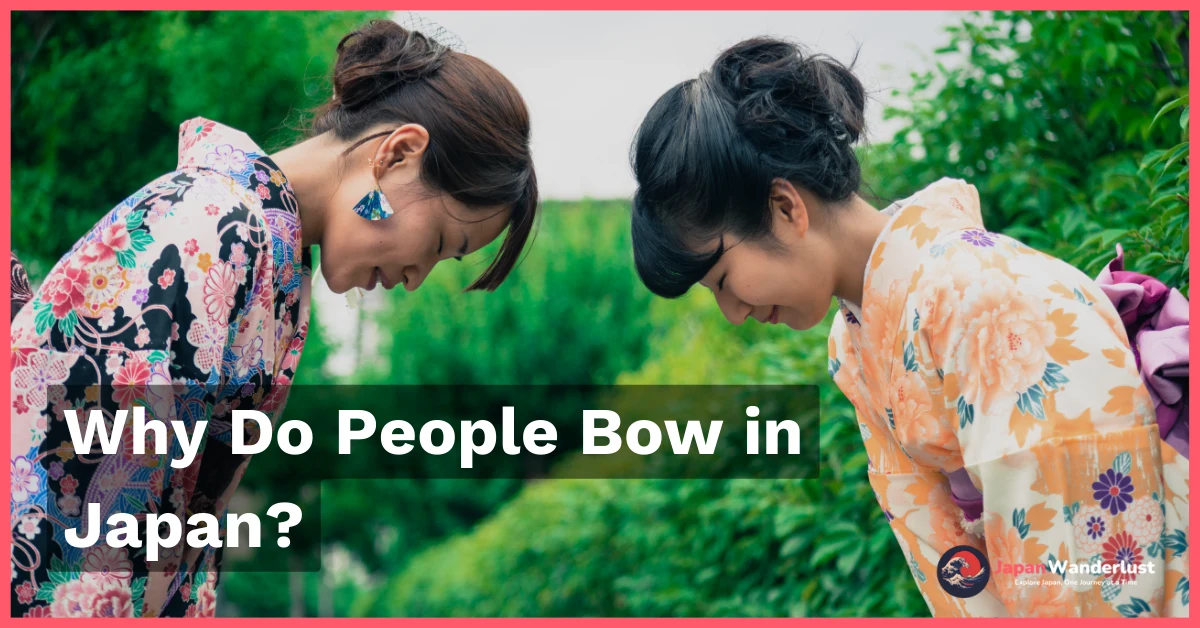
Bowing is the most fundamental gesture in Japanese etiquette, serving as the traditional method for expressing respect, gratitude, apology, and greeting. Unlike handshakes or verbal greetings common in Western cultures, bowing in Japan functions as a non-verbal communication system deeply embedded in the social fabric, with specific angles and durations conveying different levels of formality and respect.
The prevalence of bowing stems from 3 distinct types practiced in daily interactions: Eshaku (15-degree casual bow), Keirei (30-degree respectful bow), and Saikeirei (45-degree deep bow for highest respect). Each variation corresponds to specific social contexts. Eshaku works for casual encounters with acquaintances, Keirei applies to business meetings or formal introductions, and Saikeirei is reserved for apologizing, expressing profound gratitude, or addressing superiors. The angle of the bow directly correlates with the social hierarchy between individuals.
Many visitors to Japan mistakenly treat all bows as identical or attempt exaggerated versions that appear insincere to locals. While tourists aren’t expected to master the system immediately, understanding that Japanese traditional greeting protocol operates on hierarchical respect, not mere politeness, helps prevent cultural missteps. Overly casual bowing in formal settings or excessive bowing to service staff contradicts the balanced reciprocity that defines authentic Japanese etiquette.
Research from cultural historians confirms that bowing in Japan originated in Buddhist practices during the Asura period, gradually evolving into a secular social protocol by the Edo period. The gesture persists because it eliminates physical contact (valued in a high-context culture prioritizing personal space), communicates respect across language barriers, and reinforces social harmony through visible acknowledgment of hierarchical relationships.
Mastering basic bowing allows meaningful participation in Japanese social interactions rather than remaining an outsider. The 3 types serve as a practical language anyone can learn, Eshaku for daily courtesy, Keirei for professional respect, Saikeirei for sincere apology, transforming what appears as a complex ritual into a logical system for building trust through respectful acknowledgment.
What is the history of bowing in Japan?
Bowing in Japan originated during the Asuka period (538–710 CE) when Buddhist monks introduced prostration rituals from China and Korea as expressions of religious devotion. These gestures gradually transformed from purely spiritual acts into secular social protocols during the Nara and Heian periods (710–1185 CE), as aristocratic courts adopted modified bowing to demonstrate rank and political allegiance. By the time samurai culture dominated the Kamakura period (1185–1333 CE), bowing had evolved into a standardized system of non-verbal communication encoding precise hierarchical relationships.
The formalization of bowing etiquette accelerated during the Edo period (1603–1868 CE), when the Tokugawa shogunate enforced rigid social stratification that required visible displays of status acknowledgment. Samurai developed elaborate protocols distinguishing between 3 bow depths: shallow nods for equals, moderate bows for superiors, and deep prostrations for feudal lords. Merchant and artisan classes created their own parallel systems appropriate to commercial interactions. This period cemented bowing as Japan’s primary greeting method, replacing physical contact customs common in other cultures and establishing the angle-based respect language still practiced today.
Modern bowing practices retain the core structure from the Edo system while adapting to democratic social contexts where hierarchical distinctions operate more subtly. Historical records from the Meiji Restoration (1868–1912) show deliberate preservation of bowing traditions even as Japan rapidly modernized, with government officials and educators emphasizing the gesture’s role in maintaining wa (和) and collective identity. Contemporary Japanese society continues this 400-year tradition not as outdated formality but as functional communication that conveys respect, apology, gratitude, and greeting more efficiently than verbal equivalents across language barriers.
How did samurai bow in Japan?
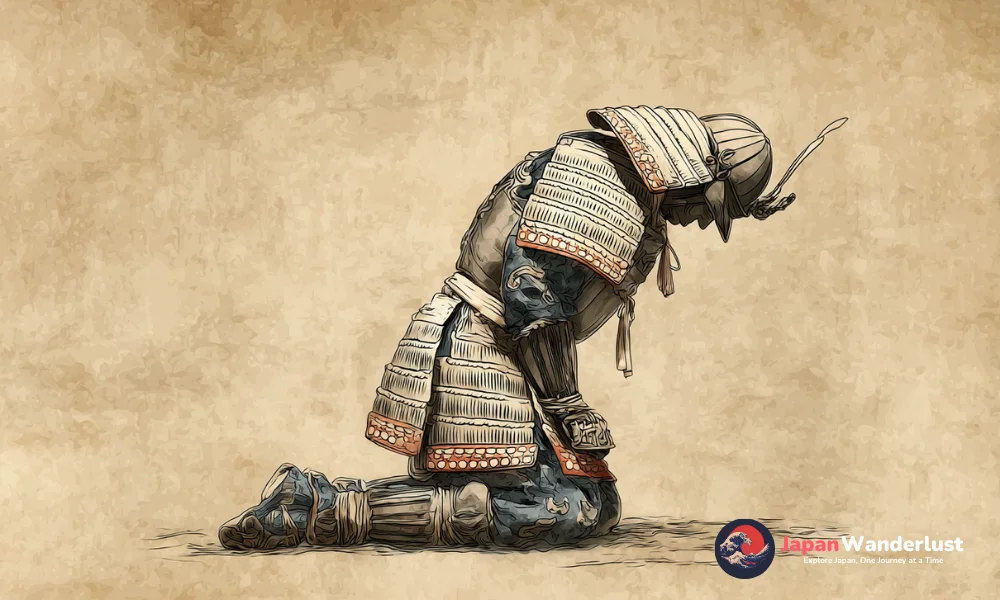
Samurai bowing operated as a strategic communication system within feudal power structures, where the depth and duration of a bow signaled military rank, political loyalty, and immediate threat assessment. Warriors performed the zarei (seated bow) during formal audiences with feudal lords, kneeling in seiza position and lowering the upper body to specific angles: 15 degrees for informal acknowledgment, 30 degrees for respectful greeting, and 45 degrees with hands placed flat on the floor for absolute submission to a superior’s authority. These weren’t mere gestures of politeness but calculated demonstrations of allegiance that could determine whether a samurai retained his position or faced accusations of disrespect punishable by forced suicide.
Court etiquette during the Muromachi and Edo periods required samurai to master 7 distinct bow variations corresponding to encounters with the shogun, daimyo lords, fellow samurai of equal rank, subordinates, merchants, priests, and enemies under truce. The rituals extended beyond physical posture to include precise breath control, eye contact duration, and the positioning of swords. A samurai never fully bowed while wearing both katana and wakizashi unless demonstrating complete trust, as the lowered head position created fatal vulnerability to attack. This practical consideration transformed bowing into a simultaneous act of respect and tactical awareness, where the willingness to assume a defenseless posture proved the sincerity of peaceful intentions while the retention of weapon access signaled measured caution.
What is the influence of Buddhism on bowing?
Buddhism introduced the foundational concept that physical prostration could manifest internal spiritual states, transforming bowing from a simple acknowledgment gesture into a meditative practice expressing humility, gratitude, and reverence. Zen Buddhist temples formalized the practice of sampai (three bows) performed before Buddha statues, with each prostration representing respect for the Buddha, dharma (teachings), and sangha (community). This triadic structure later influenced secular contexts where Japanese people bow to teachers, parents, and elders as embodiments of knowledge, family, and social wisdom. The Buddhist emphasis on eliminating ego through physical submission directly influenced the Japanese cultural value of suppressing individual pride in favor of group harmony.
The ceremonial precision of Buddhist rituals established the template for Japan’s angle-based bowing system, as monastic practices required specific degrees of inclination corresponding to the spiritual rank of the person or object being honored. Temple protocols distinguished between standing bows for casual respect, kneeling bows for formal prayer, and full prostrations where the forehead touched the ground for ultimate devotion. These gradations were later adapted by samurai and aristocratic classes into the Eshaku, Keirei, and Saikeirei framework still used today. This religious foundation explains why Japanese bowing carries emotional weight beyond mere etiquette; the gesture retains its original Buddhist function of making internal respect physically visible through controlled, deliberate body movement that requires conscious effort rather than casual execution.
What type of bow is used during formal apologies?
The bow type for formal apologies depends on the severity of the offense, the relationship between parties, and whether the apology occurs in private or public settings. Saikeirei (deepest bow) serves as the standard for sincere apologies in professional contexts, while the specific execution varies based on emotional intensity and organizational protocol.
| Bow Type | Angle | Context | Emotional Signal | Typical Occasion |
| Keirei | 30° | Minor mistakes, casual apologies | Polite acknowledgment of error | Arriving late to meeting, small service failure |
| Saikeirei | 45° | Serious mistakes, professional apologies | Deep regret and responsibility | Company scandal, major business error, personal betrayal |
| Dogeza | Full prostration (forehead to ground) | Extreme circumstances | Absolute contrition and plea for mercy | Corporate crisis, severe personal offense, traditional supplication |
Saikeirei requires holding the 45-degree position for 3–5 seconds while keeping hands at the sides or clasped in front, with eyes lowered to avoid appearing defensive or insincere. The duration matters as much as the angle. A quick 45-degree bow reads as performative rather than genuinely apologetic, while an extended hold demonstrates the apologizer’s willingness to remain in a vulnerable position until the offended party acknowledges the gesture. In corporate settings following public scandals, company executives often perform multiple Saikeirei bows in succession, with each repetition reinforcing the organization’s commitment to taking responsibility rather than deflecting blame.
Dogeza remains rare in modern Japan but appears during extreme situations requiring supplication beyond standard social protocols, such as a company president apologizing for deaths caused by product defects or an individual begging forgiveness for unforgivable personal betrayal. This full-body prostration with the forehead pressed to the floor strips away all social status, as the apologizer assumes the lowest possible physical position to signal complete submission to the injured party’s judgment. The effectiveness of any apology bow depends less on technical execution than on the sincerity conveyed through timing, facial expression, and whether the apologizer maintains the position long enough to demonstrate genuine remorse rather than rushing through a required formality.
What does bowing mean in Japan?
Bowing in Japan serves as the primary non-verbal communication method for expressing respect, gratitude, apology, and greeting within a hierarchical social framework. Unlike handshakes or verbal acknowledgments common in Western cultures, the angle and duration of a bow convey precise social meaning: a shallow 15-degree Eshaku signals casual acknowledgment, a moderate 30-degree Keirei demonstrates formal respect, and a deep 45-degree Saikeirei communicates profound reverence or sincere apology. This system functions as a visual language that immediately establishes social relationships, with the person of lower status typically initiating the bow and holding the position slightly longer to maintain wa (和) through mutual recognition of each party’s role.
Why is bowing so common in Japan?
Bowing remains the dominant greeting and acknowledgment method in Japan because it fulfills multiple social functions more efficiently than verbal or physical contact:
- Hierarchy reinforcement: The bow angle immediately signals relative social status, eliminating ambiguity about who holds authority in professional, familial, or public interactions
- Non-contact respect: Physical touch carries intimate connotations in Japanese culture, making bowing the appropriate method for showing respect while maintaining personal boundaries
- Universal comprehension: Bowing communicates across language barriers and literacy levels, functioning as a visual grammar that children, elderly citizens, foreign visitors, and business professionals all understand through observation
- Conflict avoidance: The ritualized nature of bowing provides a structured response to awkward or tense situations, allowing people to acknowledge mistakes, express gratitude, or defuse disagreements without complex verbal negotiation
- Cultural continuity: Over 400 years of standardized practice since the Edo period has embedded bowing as an automatic social reflex taught from childhood, making alternative greetings feel foreign or inappropriate in traditional contexts
What does bowing symbolize in Japan?
Beyond its practical communication functions, bowing carries layered symbolic meanings rooted in Buddhist philosophy and Confucian social values:
- Gratitude: A bow transforms internal appreciation into visible acknowledgment, particularly in service contexts where staff bow to customers as genuine thanks for patronage rather than subservience
- Apology: The willingness to lower one’s head and assume a vulnerable position physically demonstrates remorse and acceptance of responsibility, with deeper bows signaling greater contrition
- Reverence: Bowing to elders, teachers, religious figures, or the deceased expresses recognition of their spiritual, intellectual, or moral authority that transcends social rank
- Humility: The act of bending the body downward symbolizes ego suppression and rejection of arrogance, aligning with Buddhist teachings on eliminating pride to achieve harmony
- Sincerity: Unlike verbal apologies or thanks that can be spoken insincerely, a properly executed bow requires physical effort and time, making it harder to perform dishonestly and more trustworthy as a signal of genuine intent
Do men and women bow differently?
Traditional Japanese etiquette prescribes distinct bowing styles based on gender, though these differences have diminished in modern professional contexts:
- Hand placement: Women typically place hands together in front of the body or clasp them at thigh level during a bow, while men keep arms straight at the sides with hands flat against the legs
- Bow depth for equivalent respect: Women often bow slightly deeper than men when showing the same level of respect, a practice originating from historical expectations that women demonstrate more visible deference
- Standing posture: Women maintain feet closer together (often in a slight pigeon-toed stance) before and after bowing, whereas men stand with feet shoulder-width apart in a more grounded position
- Kneeling bows: The seated zarei bow differs significantly, women kneel with legs folded to one side (yokozuwari) while men use the formal seiza position with both legs tucked directly beneath the body
- Professional settings: Modern corporate environments increasingly standardize bowing across genders, with business protocol manuals teaching identical angles and hand positions to male and female employees to emphasize professionalism over traditional gender distinctions
What is bowing in Japanese culture?
Bowing in Japanese culture functions as the foundational social mechanism for regulating interpersonal relationships, maintaining group harmony, and navigating hierarchical structures in daily life. The practice operates as a non-verbal protocol that simultaneously communicates respect, acknowledgment, and social positioning through precisely calibrated physical gestures, with Japanese people performing an estimated dozens of bows daily in routine interactions ranging from greeting neighbors to conducting business transactions.
Unlike cultures where greetings rely primarily on verbal exchange or physical contact, Japanese society uses bowing as the default interface for entering and exiting social encounters, making it the most visible and frequently practiced element of reigi (proper etiquette). The system’s efficiency lies in its ability to convey complex social information instantly: the depth, duration, and timing of a bow communicate the relationship between parties, the formality of the context, and the emotional content of the interaction without requiring explicit verbal negotiation that might disrupt the cultural preference for indirect communication.
Is it rude not to bow in Japan?
Foreigners who don’t bow in Japan typically aren’t considered rude as long as they show respect through other culturally appropriate means like polite verbal greetings or attentive body language. Japanese people generally extend cultural grace to visitors, understanding that bowing is a learned behavior deeply embedded in their own socialization from childhood rather than an intuitive gesture for outsiders. However, the context determines whether omitting a bow causes offense: failing to bow when meeting a business partner’s executive team, receiving a formal apology, or being introduced to elderly family members signals disrespect regardless of your nationality, as these situations demand visible acknowledgment of hierarchy and occasion significance.
The rudeness threshold depends more on the relationship and setting than on perfect technical execution. Japanese colleagues will overlook an awkward or shallow bow from a foreign coworker who’s clearly attempting the gesture, but deliberately standing rigid with crossed arms while someone bows to you reads as hostile rejection of the social contract. In service contexts like restaurants or hotels, staff will continue bowing whether customers reciprocate or not, as their bows fulfill professional protocol rather than expecting mutual exchange. The key distinction: not knowing how to bow properly is forgivable, but visibly refusing to acknowledge someone’s bow when the situation clearly calls for basic respect crosses into genuinely rude behavior that even cultural outsider status won’t excuse.
When do Japanese people bow?
Japanese people bow in specific situational contexts that trigger the gesture as an automatic social response:
- Greetings and farewells: Meeting someone for the first time, arriving at work, encountering neighbors, or saying goodbye after social visits
- Gratitude expressions: Receiving gifts, service, assistance, or compliments, with the bow depth corresponding to the favor’s significance
- Apologies and requests: Acknowledging mistakes, asking for help, seeking forgiveness, or making formal petitions to superiors
- Business interactions: Opening and closing meetings, exchanging business cards, welcoming clients, or concluding negotiations
- Ceremonial occasions: Weddings, funerals, tea ceremonies, martial arts training, shrine visits, or New Year’s celebrations
- Service transactions: Entering stores, completing purchases, hotel check-ins, restaurant greetings, or elevator operators acknowledging passengers
- Hierarchical acknowledgment: Students greeting teachers, employees addressing managers, junior family members honoring elders, or citizens showing respect to public officials
- Performance contexts: Actors acknowledging audiences, musicians beginning concerts, speakers opening presentations, or athletes bowing to opponents and judges
Do you speak while bowing or after?
The timing of speech relative to bowing follows strict etiquette rules that vary by context and formality level:
- Casual bows: Brief verbal greetings like “ohayō gozaimasu” (good morning) or “arigatō gozaimasu” (thank you) can occur simultaneously with shallow Eshaku bows in informal daily interactions
- Formal bows: The Keirei and Saikeirei require silence during the bow itself, with verbal statements delivered either immediately before beginning the bow or after returning to upright position
- Business card exchange: Say “hajimemashite” (nice to meet you) and your name before bowing, present the card while bowing, then add company details after straightening up
- Apology protocol: State the apology “mōshiwake gozaimasen” (I sincerely apologize) before bowing, hold the Saikeirei position in silence for 3-5 seconds, then wait for acknowledgment before speaking again
- Gratitude timing: Express thanks verbally before or after the bow depending on formality. Casual thanks can accompany a quick bow, but formal gratitude requires speaking first, bowing in silence, then elaborating if needed
- Never interrupt a bow: Continuing to talk while someone else is bowing to you is considered disrespectful, as it suggests you’re not giving their gesture proper attention
- Phone etiquette: Japanese people often bow while speaking on the phone even though the other person can’t see them, reflecting how deeply ingrained the gesture-speech coordination has become in expressing respect
What are the three main types of bowing in Japan?
The three main types of bowing in Japan operate as a graduated system of non-verbal communication: Eshaku (15-degree casual bow), Keirei (30-degree formal bow), and Saikeirei (45-degree deep bow). Each type corresponds to specific social contexts and formality levels, with the angle and hold duration conveying precise degrees of respect, gratitude, or apology within Japan’s hierarchical social framework.
| Bow Type | Angle | Formality | Primary Context | Hand Position | Hold Duration |
| Eshaku | 15° | Casual | Daily greetings, acquaintances, casual encounters | Arms at sides, hands on thighs | 1 second or less |
| Keirei | 30° | Formal | Business meetings, introductions, showing respect | Arms at sides, hands on thighs | 2-3 seconds |
| Saikeirei | 45° | Highest formality | Apologies, deep gratitude, addressing superiors | Arms at sides or hands clasped front | 3-5 seconds |
Eshaku
Eshaku (15-degree bow) serves as the standard greeting for everyday casual interactions, functioning as Japan’s equivalent to a Western nod or wave. This shallow bow appears in routine encounters like passing coworkers in hallways, greeting neighbors, acknowledging service staff, or saying goodbye to acquaintances after brief conversations. The gesture requires minimal physical effort and time commitment, making it suitable for situations where full formal protocol would slow down daily activities or create unnecessary social distance between people of roughly equal status. Japanese people perform Eshaku dozens of times daily without conscious thought, as the shallow angle allows the gesture to blend seamlessly into walking, talking, or multitasking rather than requiring a full stop to execute properly.
Reference the comparison table above for detailed angle, formality, and context specifications.
Keirei
Keirei (30-degree bow) represents the standard formal bow for professional and respectful social interactions, striking the balance between casual acknowledgment and profound reverence. This moderate-depth bow dominates business environments during client meetings, job interviews, formal introductions, and professional presentations, where participants need to demonstrate respect without implying the extreme deference of deeper bows. The 30-degree angle requires visible effort and attention, forcing the bower to pause their other activities and focus entirely on the gesture for 2-3 seconds. This deliberate quality makes Keirei the appropriate choice when you want to show genuine respect rather than casual acknowledgment, yet the relationship doesn’t warrant the apologetic or supplicatory connotations of Saikeirei.
Reference the comparison table above for detailed angle, formality, and context specifications.
Saikeirei
Saikeirei (45-degree bow) constitutes the deepest standard bow in Japanese etiquette, reserved for expressing profound respect, sincere apology, or deep gratitude in situations carrying significant emotional or hierarchical weight. This formal bow appears when employees meet company executives, students address honored teachers, individuals apologize for serious mistakes, or people express gratitude for life-changing favors. The 45-degree angle positions the bower in a genuinely vulnerable posture where they cannot easily monitor their surroundings, making the extended 3-5 second hold a trust signal that demonstrates the bower’s willingness to assume risk as proof of their sincerity. Unlike casual Eshaku that people perform reflexively, Saikeirei demands conscious intention and visible effort, which is precisely what gives the gesture its power to communicate emotions that words alone cannot adequately convey.
Reference the comparison table above for detailed angle, formality, and context specifications.
How long should you hold a bow?
The proper execution of a bow follows a four-phase sequence with specific timing for each stage:
- Preparation (1 second): Stand upright with feet together (women) or shoulder-width apart (men), arms straight at sides with hands resting on thighs, eyes focused forward, and body relaxed but attentive to signal readiness for the gesture.
- Bending (1-2 seconds): Lower your upper body from the hips in a smooth, controlled motion to the target angle (15°, 30°, or 45°), keeping your back straight, neck aligned with spine, and eyes directed downward following the angle of your torso rather than looking up at the other person.
- Holding (1-5 seconds): Maintain the bowed position in complete stillness for the duration appropriate to the bow type: 1 second or less for Eshaku, 2-3 seconds for Keirei, 3-5 seconds for Saikeirei, with the person of lower status typically holding slightly longer than their superior.
- Return (1-2 seconds): Rise smoothly back to upright position at the same controlled pace used for bending, avoid rushing the return motion (which signals insincerity or impatience), and maintain eye contact downward until fully upright before looking at the other person’s face.
How to bow respectfully?
To bow respectfully in Japan, follow this step-by-step sequence that ensures proper form and cultural appropriateness:
- Establish proper standing position: Stand upright with your back straight, shoulders relaxed, and feet positioned shoulder-width apart (men) or close together (women), facing the person you’re greeting with your body squared to theirs.
- Position your hands correctly: Place your hands flat against the front of your thighs with fingers together and pointing downward (men) or clasp your hands loosely in front of your body at thigh level (women).
- Make brief eye contact: Look at the person’s face for 1-2 seconds before beginning the bow to acknowledge their presence and signal your intention to bow.
- Bend from the hips: Lower your upper body in a smooth, controlled motion by hinging at the hips while keeping your back straight and neck aligned with your spine, avoiding any curving or slouching of the shoulders.
- Match the appropriate angle: Stop at 15 degrees for casual greetings (Eshaku), 30 degrees for formal respect (Keirei), or 45 degrees for deep respect or apology (Saikeirei), using the person’s status and situation to determine which angle is appropriate.
- Hold the position: Remain completely still at the bottom of the bow for the appropriate duration: 1 second for Eshaku, 2-3 seconds for Keirei, or 3-5 seconds for Saikeirei, with junior people holding slightly longer than seniors.
- Return to upright smoothly: Rise back to standing position at the same controlled pace you used when bending, keeping your hands in position and eyes lowered until you’re fully upright.
- Resume normal posture: Once upright, you may look at the other person’s face again and continue with conversation or proceed to your next activity.
Correct posture when bowing
Proper bowing posture requires executing three distinct phases with precise body alignment:
- Align your body before bowing: Stand with feet positioned appropriately (shoulder-width for men, close together for women), back completely straight from tailbone to neck, shoulders pulled back but relaxed, chin level with the ground, and arms hanging naturally at your sides with hands resting on the front of your thighs.
- Bend while maintaining alignment: Hinge forward from the hip joints (not the waist or lower back) in a single smooth motion, keeping your spine in a straight line from your tailbone through the top of your head, allowing your arms to follow naturally with hands sliding slightly down your thighs, and directing your gaze downward to follow the angle of your torso rather than looking up at the other person.
- Return to neutral position: Push through your hips to rise back to standing at a controlled, deliberate pace that matches the speed of your descent, maintain the straight spine alignment throughout the upward motion without jerking or rushing, and keep your neck in line with your back rather than lifting your head first, completing the movement only when you’ve returned to the exact starting position.
How low should you bow?
The depth of your bow communicates specific social messages through precise angle measurements:
| Bow Angle | Bow Type | Meaning/Intent | Appropriate Context |
| 5-10° | Casual nod | Quick acknowledgment, minimal respect | Passing strangers, repeat encounters same day |
| 15° | Eshaku | Polite greeting, casual respect | Coworkers, acquaintances, neighbors, daily interactions |
| 30° | Keirei | Formal respect, professional courtesy | Business meetings, formal introductions, showing appreciation |
| 45° | Saikeirei | Deep respect, sincere apology, profound gratitude | Company executives, serious mistakes, major favors |
| 70-90° | Dogeza | Extreme contrition, supplication | Corporate scandals, unforgivable offenses, traditional pleas |
Where to place your hands when bowing
Hand placement during bowing differs based on gender, formality, and bow type:
Men’s hand positions:
- Keep arms straight and close to the body with hands resting flat against the front of the thighs
- Fingers should be together and pointing straight down toward the knees
- Hands remain in this position throughout the entire bow sequence
- For Saikeirei while seated (zarei), place hands flat on the floor in front of the knees
Women’s hand positions:
- Clasp hands loosely together in front of the body at upper thigh level
- Alternatively, place the right hand over the left hand, both resting gently against the front of the thighs
- During deeper bows, hands may slide down slightly but remain together
- For formal seated bows, place hands flat on the floor with fingertips touching to form a triangle
How should tourists bow in Japan?
Tourists can successfully navigate Japanese bowing customs by following this beginner-friendly sequence:
- Observe the situation first: Watch how Japanese people around you are bowing before attempting it yourself, noting the depth and speed of their bows to gauge the formality level.
- Start with a simple nod: If you’re uncertain about the proper protocol, a small forward head nod of about 10-15 degrees with a smile communicates respect without risking major etiquette errors.
- Place hands at your sides: Keep your arms relaxed with hands resting naturally against the front of your thighs, avoiding the temptation to put hands in pockets, cross arms, or hold them behind your back.
- Bend from your hips: Lower your upper body by hinging at the hips to approximately 15-20 degrees (a “safe” angle for tourists that shows respect without overdoing it), keeping your back relatively straight rather than curving your shoulders.
- Hold briefly: Pause at the bottom of the bow for about 1-2 seconds, which is long enough to show sincerity but short enough to avoid awkwardness if you’re unsure of the proper duration.
- Return smoothly: Rise back to standing at a controlled pace, maintaining eye contact downward until you’re upright, then look at the person and smile.
- Don’t overthink it: Japanese people appreciate any genuine attempt to respect their customs, so a slightly imperfect bow with sincere intention is far better than avoiding the gesture entirely out of fear of making mistakes.
Is it okay for foreigners to bow in Japan?
Foreigners bowing in Japan is not only acceptable but generally appreciated as a sign of cultural respect and willingness to engage with Japanese customs. Japanese people understand that bowing is a culturally specific practice requiring years of socialization to master, so they don’t expect foreign visitors to execute perfect technique or know all the nuanced rules governing different bow types and contexts. A sincere attempt at bowing, even if technically imperfect, demonstrates respect for Japanese culture and effort to meet locals partway in their communication style, which typically generates positive responses and helps build rapport in both casual and professional interactions.
The key consideration is matching your bowing to the context and your comfort level. In highly formal business situations, especially when representing your company in negotiations or meetings with senior executives, making an effort to bow appropriately shows professionalism and cultural awareness that can positively influence business relationships. However, in casual tourist contexts like shopping, dining, or sightseeing, Japanese people don’t expect foreigners to bow and won’t be offended if you simply say thank you verbally or nod politely.
The middle ground works well for most situations: a simple 15-degree bow when greeting someone, receiving service, or expressing thanks strikes the right balance between cultural participation and not overstepping your knowledge level. What matters most is the intention behind the gesture rather than perfect execution, as Japanese people can easily distinguish between a genuine attempt to show respect and an exaggerated or mocking imitation.
Common mistakes tourists make when bowing
Tourists frequently make these bowing errors that undermine the gesture’s respectful intent:
- Slouching or curving the back: Rounding the shoulders and bending from the waist instead of hinging from the hips creates a casual, sloppy appearance that contradicts the gesture’s purpose of showing respect
- Just nodding the head: Bobbing only the head while keeping the torso upright reads as dismissive or lazy rather than a proper bow, similar to the difference between a sincere handshake and a limp finger touch
- Bowing too deep for the context: Foreign visitors often perform exaggerated 45-degree bows in casual situations where a 15-degree bow is appropriate, making the gesture seem performative or insincere
- Maintaining eye contact during the bow: Staring at someone’s face while bowing contradicts the humility the gesture is meant to express, as proper form requires looking downward
- Rushing the bow: Jerking quickly down and up makes the bow appear perfunctory rather than respectful, especially problematic when the other person is holding a longer, more formal bow
- Bowing with hands in pockets: Keeping hands in pockets, crossed, or behind the back during a bow signals casualness that undermines the respect the gesture is meant to convey
- Bowing while walking: Attempting to bow while moving forward or backward creates an awkward, unstable motion that looks careless rather than respectful
- Talking continuously while bowing: Maintaining a stream of chatter during the bow distracts from the gesture’s non-verbal communication and makes it seem like an afterthought rather than a meaningful acknowledgment
- Bowing at the wrong time: Bowing when receiving change in a store or after every single sentence in conversation overdoes the gesture, making it lose its meaning
Should I bow when someone bows to me?
You should generally return a bow when someone bows to you in social or business settings, but you can skip it when receiving service from staff who bow as part of their job duties. The basic rule is simple: if someone bows to you as a greeting, introduction, or expression of gratitude in a mutual exchange, returning the bow at approximately the same depth shows respect and acknowledges their gesture. Think of it like a handshake—when someone extends their hand, you naturally extend yours back.
However, service workers like store clerks, restaurant staff, and hotel employees bow as part of their professional protocol and don’t expect customers to return each bow. If you’re shopping and a clerk bows as you enter or leave, a small nod or smile is perfectly appropriate, but you’re not required to perform a full return bow. The same applies when you’re clearly in a customer or guest role—the hierarchical relationship built into Japanese service culture means staff will continue bowing whether you reciprocate or not.
When in doubt, match what the other person does. If someone gives you a quick 15-degree bow, return a similar bow. If they perform a deeper 30-degree bow, acknowledge it with a comparable gesture. A general principle that works in most situations: returning the bow is rarely wrong, but you won’t offend anyone by offering a polite nod instead, especially as a foreigner navigating unfamiliar customs. The key is acknowledging the gesture in some way rather than standing rigid or ignoring it completely, which can read as dismissive regardless of your cultural background.
How do you bow in Japanese business settings?
Bowing in Japanese business settings operates as the cornerstone of professional etiquette, functioning as a precise communication system that establishes hierarchy, demonstrates respect, and maintains the formal atmosphere essential to corporate relationships. Unlike casual social bowing where a quick 15-degree nod suffices for most interactions, business contexts require deliberate execution of 30-degree Keirei bows as the standard professional greeting, with the depth, duration, and timing calibrated to signal your company’s respect for the business relationship.
The formality extends beyond the physical gesture to encompass the entire greeting ritual. Japanese businesspeople combine bowing with the exchange of meishi (business cards) in a choreographed sequence where both parties present cards while bowing, creating a dual acknowledgment of individual and corporate identity. This precision matters because business bowing serves strategic functions: establishing pecking order in negotiations, demonstrating sincerity during apologies, and reinforcing corporate culture through visible displays of respect that verbal communication alone cannot achieve.
The stakes are higher than casual social bowing. A poorly executed bow in a client meeting can undermine your company’s credibility, while proper bowing protocol signals professionalism, cultural competence, and serious commitment to the business relationship. In Japanese corporate culture, how you bow often carries as much weight as what you say during negotiations.
What’s the differences between casual and corporate bowing?
Casual social bowing and corporate business bowing differ significantly in execution, purpose, and social expectations:
| Aspect | Casual Bowing | Corporate Bowing |
| Standard angle | 15° (Eshaku) | 30° (Keirei) |
| Hold duration | 1 second or less | 2-3 seconds minimum |
| Frequency | As needed, often multiple quick bows | Deliberate, measured bows at specific moments |
| Primary purpose | Quick acknowledgment, daily courtesy | Demonstrate professional respect, establish hierarchy |
| Accompanying language | Casual greetings (ohayō, konnichiwa) | Formal business phrases (yoroshiku onegaishimasu) |
| Precision required | Approximate angle acceptable | Exact 30° angle expected |
| Context flexibility | Can bow while walking, talking, multitasking | Requires full stop and focused attention |
| Hand position | Relaxed, less critical | Strict positioning (men: sides, women: front) |
| Eye contact | Brief glance acceptable | Eyes down throughout bow |
| Consequence of error | Generally overlooked | Can damage business relationship or company reputation |
When to bow in Japanese business meetings?
Business meetings in Japan follow a structured bowing protocol at specific moments throughout the interaction:
- Upon arrival at the meeting location: Bow to the receptionist or person who greets you at the entrance, then bow again when entering the meeting room before anyone sits down, with the visiting party bowing first to acknowledge they are in the host’s space.
- During formal introductions: Exchange business cards while performing a 30-degree Keirei bow, holding the card with both hands and presenting it so the text faces the recipient, bowing as you hand over your card and receive theirs, then bowing again after reading their card to show you’ve acknowledged their name and position.
- At the start of the meeting: Once everyone is seated, the senior person from each side stands and bows to signal the official beginning of discussions, with all attendees standing and bowing in response to acknowledge their participation in the meeting.
- When expressing gratitude or apology: Stand and bow whenever thanking someone for information, apologizing for a mistake or delay, or acknowledging a concession, with the depth of the bow (30° or 45°) matching the significance of what you’re expressing.
- When presenting or receiving important documents: Bow when handing over proposals, contracts, or reports, and bow when receiving similar documents, treating the physical exchange as a moment worthy of formal acknowledgment.
- At the conclusion of negotiations: Bow when agreement is reached or when postponing decisions to the next meeting, with the bow signaling acceptance of the current outcome regardless of whether it favors your position.
- Upon leaving the meeting room: Stand and bow to everyone present before departing, with the visiting party bowing first, then wait for the host party to return the bow before actually leaving the room.
- Final departure from the building: Bow one last time to anyone who has escorted you to the exit or elevator, maintaining the formal acknowledgment until you’ve completely left the host company’s premises.
Bowing vs handshake in Japanese business culture
Navigating the choice between bowing and handshaking in Japanese business contexts depends on the situation and participants:
| Situation | Appropriate Greeting | Execution Notes |
| Meeting with traditional Japanese executives | Bow only (30° Keirei) | Handshakes may be seen as overly Western or inappropriate for formal contexts |
| Meeting with internationally experienced Japanese businesspeople | Bow + handshake hybrid | Bow first, then shake hands if the Japanese party extends their hand |
| Japanese company meeting Western clients | Handshake + slight bow | Japanese hosts often initiate handshake to accommodate Western customs, add small bow for respect |
| Initial meeting with unknown protocol preference | Wait and mirror | Let the Japanese party initiate; match whatever greeting they offer |
| Meeting with Japanese colleagues you know well | Casual bow (15° Eshaku) | Relationship familiarity allows less formal greeting unless senior executives present |
| International conference or trade show | Handshake acceptable | Neutral territory reduces expectation of traditional Japanese protocol |
| Meeting after significant business success | Bow then handshake | Bow to show respect, handshake to celebrate mutual achievement in Western style |
| Apologizing for business error | Bow only (45° Saikeirei) | Handshake inappropriate when expressing serious apology; bow shows contrition |
Key decision principle: When in doubt, bow first and let the Japanese party determine if they want to add a handshake. This shows cultural respect while remaining open to their preferred greeting style.
How is Japanese bowing different from Korean bowing?
Japanese and Korean bowing share historical roots but have evolved distinct protocols reflecting different cultural values:
| Aspect | Japanese Bowing | Korean Bowing |
| Standard casual angle | 15° (Eshaku) | 30° (basic jeol) |
| Standard formal angle | 30° (Keirei) | 45° (formal keunjeol) |
| Deepest traditional bow | 45° (Saikeirei) or 90° (Dogeza) | 90° full prostration (keunjeol for elders) |
| Hand placement (men) | Arms straight at sides, hands on thighs | Right hand over left fist at waist level |
| Hand placement (women) | Hands clasped in front at thigh level | Hands clasped in front at waist level, slightly higher than Japanese style |
| Upper body posture | Straight back, hinge from hips | Slight curve allowed, more flexible spine position |
| Frequency in daily life | Dozens of bows daily for routine interactions | Less frequent; reserved for meaningful encounters |
| Business context usage | Required for all professional interactions | Common but less rigid than Japanese corporate culture |
| Greeting hierarchy | Lower status person bows first and deeper | Younger/junior person bows first; elder may nod in return |
| Eye contact during bow | Eyes down, following torso angle | Brief eye contact acceptable before and after bow |
| Standing position | Feet shoulder-width (men) or together (women) | Feet closer together for both genders |
| Cultural emphasis | Precision, exactness of angle and duration | Sincerity of intention over technical perfection |
| Seated bowing | Formal seiza position on knees | Similar kneeling but upper body bows deeper more frequently |
Primary cultural difference: Japanese bowing emphasizes the exact angle and duration as markers of respect and social hierarchy, while Korean bowing focuses more on the emotional sincerity behind the gesture. Koreans generally bow deeper than Japanese for equivalent situations but with less concern about precise degree measurements.
Ready to Try This Etiquette in Real Japan?
Reading about bowing is one thing. Feeling when to use Eshaku, Keirei, or Saikeirei in an actual conversation is where it really starts to make sense. Once you’re in Tokyo trains, neighborhood streets, and local shops, bowing stops being a “rule” and becomes a natural part of how you say hello, thank you, and sorry.
If you want to practice Japanese etiquette while actually exploring the city, a private tour with a bilingual guide is one of the easiest ways to do it. You can ask questions on the spot, get gentle corrections, and see how locals bow in different situations without worrying about making a big mistake.
- Discover Tokyo with a local guide and learn etiquette as you go: Tokyo Private Tours
- Combine cultural manners with iconic scenery and day-trip adventure: Mt. Fuji Private Tour