
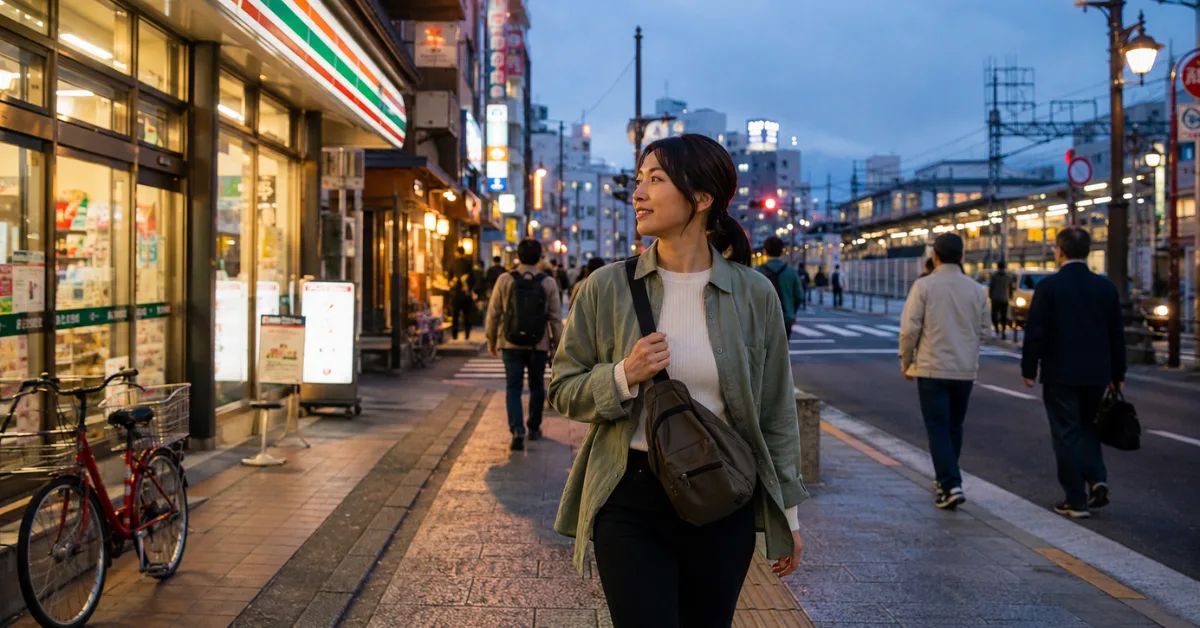
Yes, Japan is genuinely one of the safest countries on earth for women traveling alone, and that is not marketing copy. It is a felt reality that takes about six hours on the ground to understand.
What makes Japan different is the specific texture of its safety. Violent crime against tourists is extremely rare. Petty theft is uncommon to the point where people leave laptops on café tables and come back to find them untouched. There is no catcalling culture. Children commute to school alone on the subway. These are not statistics: they are the observable daily reality of Japanese cities, and they produce a quality of ease that most solo female travelers report as unlike anywhere else they have been.
That said, Japan’s safety comes with its own specific risks. Train groping (chikan), nightlife scams, and cultural isolation are all real and worth understanding before you land. None of these should stop you from going. This guide covers the actual risk landscape, the practical tools that make solo female travel in Japan work well, and the specific situations you should know about. It is written for women who want an honest answer.
Is Japan actually safe for solo female travelers?
Yes, Japan has one of the lowest violent crime rates in the world, and solo women regularly report feeling safer here than in their home countries. I have spent considerable time travelling with visitors across Tokyo, and the observation that consistently surprises people is not the temples or the food. It is how unbothered they feel walking alone at midnight.
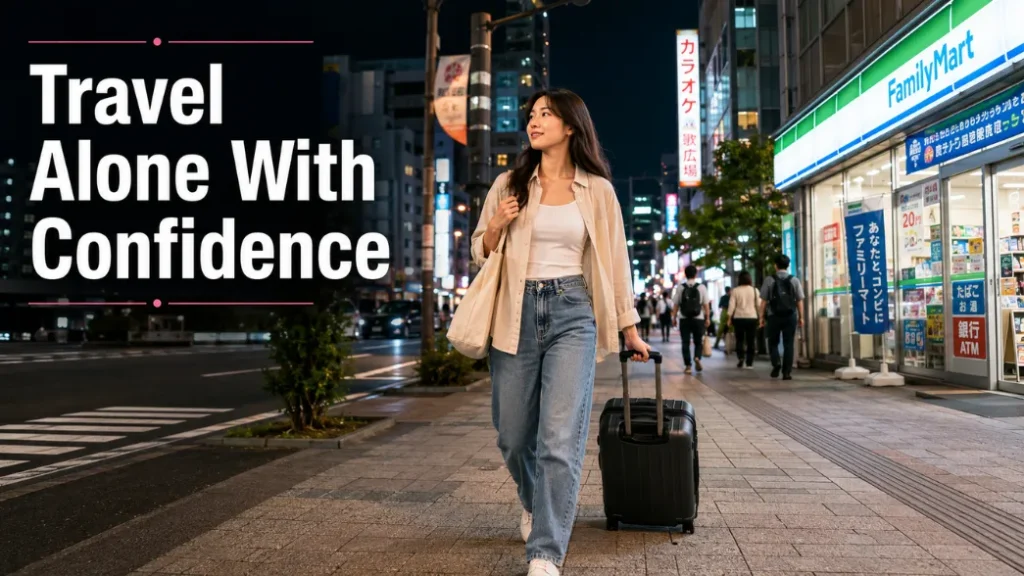
The cultural foundation for this is wa: Japan’s deeply embedded social norm of harmony and collective order. This norm shapes behaviour at every level. It is why children commute on the Tokyo Metro unsupervised. It is why a lost wallet is almost always turned in to the nearest koban (a police box: a small neighbourhood police station found in virtually every area of Japan, including rural ones). It is why you will walk down a busy street in Shinjuku at 1am and not once be shouted at.
Being a foreign woman does not make you a specific target. The National Police Agency data consistently shows that violent crime against tourists is exceptionally rare. I have spoken with solo female travelers who have visited Japan three, four, five times. None of them reports ever feeling physically threatened.
Is it safe to walk alone at night in Japan?
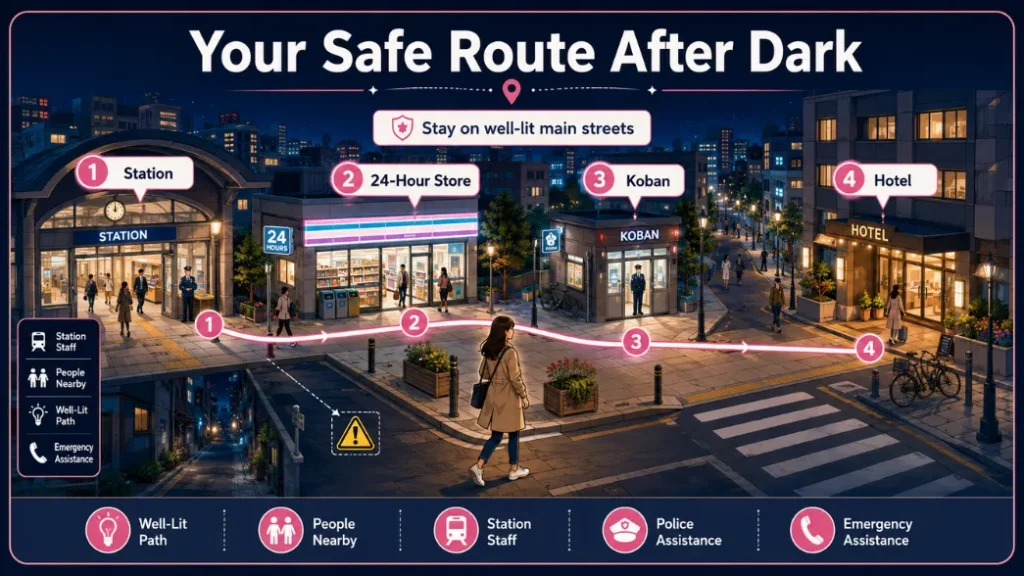
Major Japanese cities remain well-lit, populated, and safe to walk alone at night. Tokyo, Kyoto, and Osaka do not empty out after dark. Convenience stores (7-Eleven, Lawson, FamilyMart) are open 24 hours and serve as natural waypoints if you ever feel disoriented. They are well-staffed, frequently visited, and practically universal.
Standard common sense still applies. Stick to main streets and well-lit areas if you are in an unfamiliar neighbourhood. The baseline level of threat in Japan at night is materially lower than in most comparable cities elsewhere.
What should I do if something goes wrong?
Japan has a reliable emergency infrastructure, and knowing where to go removes most of the anxiety. The koban is your first contact point: police at a koban are trained to assist, speak enough functional English to help orient you, and are easier to reach than calling a general emergency line.
Police are reachable at 110; ambulance and fire at 119.
Save the Japan Visitor Hotline number before you travel: 050-3816-2787.
It operates 24 hours a day, seven days a week, with English-speaking staff who can assist with emergencies, lost passports, and medical situations. Google Translate works well enough with koban staff for basic communication.
Do Japanese people actually help if you’re in trouble?
Yes. The cultural reserve of everyday Japanese social interaction is not the same as indifference. In daily life, Japanese people tend to keep to themselves and do not initiate conversation. But a woman who is visibly lost, distressed, or in difficulty will almost always be approached.
In my experience, the two situations produce completely different responses. Station staff who notice a confused foreigner with a large bag will walk across the concourse unprompted to help. The reserve dissolves when someone clearly needs assistance. What you should not expect is the casual street friendliness of Southeast Asia. What you can rely on is genuine help when it matters.
What are the real risks for women travelling solo in Japan?
The main safety risks specific to women in Japan are train groping (chikan), nightlife scams in specific districts, and a smaller but real category of crimes against women that are underreported. None of these should stop you from going, but each deserves a clear-eyed look rather than a dismissive mention.
What is chikan and how common is it?
Chikan refers to groping on crowded trains, and also to the person who commits it. It is a documented problem on Japan’s urban rail network, not an urban myth. As of 2023, Savvy Tokyo data citing National Police Agency reports identifies the JR Musashino, JR Takasaki, and Tobu Tojo lines as the three worst in Tokyo.
Here is the context that most articles skip: chikan disproportionately targets Japanese teenage girls and young commuters, not foreign tourists. Estimates suggest over 40% of Tokyo women have experienced it at some stage, but this figure reflects the full commuter population across years. As a solo female traveler, your exposure is real but lower than those headline numbers suggest.
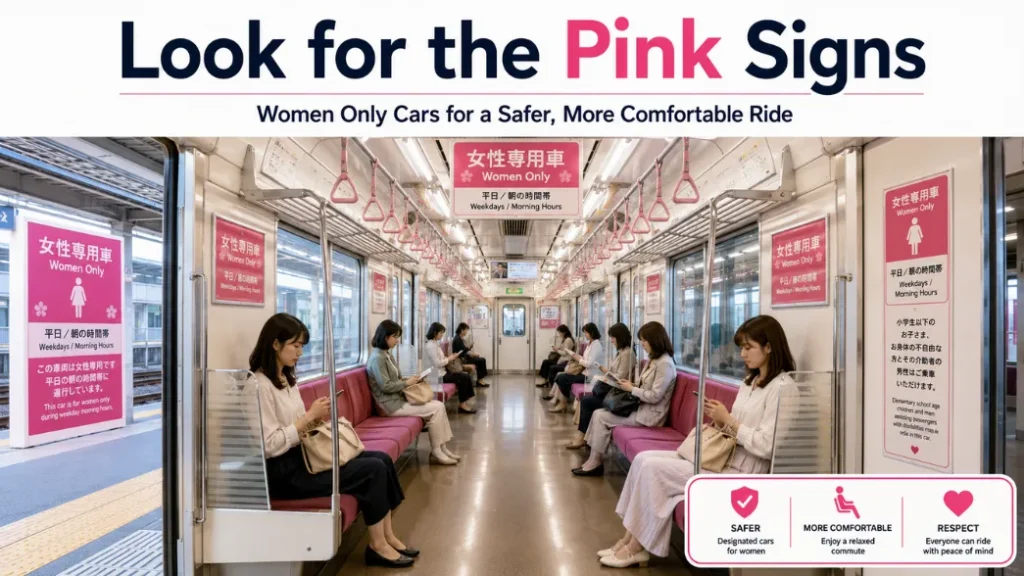
The structural solution is the women-only car. These operate on most major lines in Tokyo, Osaka, and Kyoto during peak commute hours on weekdays. On the platform, look for pink signage indicating where the women-only car stops. When these cars are available, use them.
What do I do if chikan happens to me?
The most effective response is to act immediately. Do not stay silent: silence is the single thing that allows this to continue.
Grab the person’s hand, hold it up, and shout “Chikan!” loudly. If you do not feel comfortable with that word, “Yamete!” means “Stop.” Exit the train at the next station, take the person with you if possible, and immediately tell station staff. Train station staff deal with this regularly and know the procedure. The Tokyo Metropolitan Police Department guidance specifically notes that staying silent makes the situation worse.
Is it safe for women to go to clubs and nightlife venues alone in Japan?
Going to an actual nightclub alone carries more risk than the general nightlife caution covered above, particularly in Roppongi’s club district. Regular bars and casual nightlife spots are usually fine solo. Dedicated clubs that court foreign customers are a different risk category.
Clubs in this district often run “ladies free” promotions, letting women in free to fill the room for paying male customers. That doesn’t make the venue dangerous by itself. It does mean solo women get heavy attention once inside.
There have been long-running reports of drink spiking in Roppongi nightlife areas, and embassy warnings have advised people not to go clubbing alone and to stay alert with drinks.
Most safety guides group bars and clubs under one nightlife warning. A quiet bar in Shibuya and a packed club in Roppongi carry different risk levels.
Order your own drink and watch it get poured. Don’t leave a glass unattended at the table.
Some clubs add a “table charge,” a mandatory per-seat fee not stated upfront. If that charge turns into a bill dispute, don’t pay under pressure. Walk out and go straight to the nearest koban.
Book your own ride home through the GO app instead of accepting transport arranged by someone inside the venue.
Which nightlife areas carry the most risk?
Kabukicho in Shinjuku, Roppongi, Ikebukuro, and Shinsekai in Osaka carry the highest concentration of scam risk for foreign women, particularly late at night.
The mechanics matter. Touts (men handing out flyers or verbally inviting people into bars) are common in these areas. Most are harmless hustlers. Some, however, steer people into bars that run a deliberate scam: they lure you in, run up a bill you did not agree to, and sometimes use intimidation to force payment. Drink spiking has been reported in some of these venues.
The rule is straightforward: never follow a stranger into an unmarked building, an upstairs bar, or any venue where you did not find the door yourself. Stay on your own terms, go with others when exploring these specific areas, and trust any pushiness that feels off.
Is Japan right for you as a first-time solo traveler?
Japan is excellent for solo female travelers with some travel experience. For first-timers who have never travelled solo before, it is worth being specific about what to expect: Japan is safe, but “safe” and “easy” are different things.
The language barrier is real. In tourist-heavy areas of Tokyo and Kyoto, you will manage fine. Outside those areas, English thins quickly, signs switch to Japanese-only characters, and communication with older locals becomes a genuine challenge. Google Translate handles most day-to-day situations adequately. The cognitive load of constantly bridging that gap adds up over a long trip alone.
The cultural reserve can feel isolating. Japanese society does not work the way Southeast Asia or Southern Europe does, where strangers talk easily and social connection happens naturally. After several weeks travelling solo in Japan, I have heard people describe a specific kind of loneliness that has nothing to do with safety and everything to do with the absence of casual human warmth. If you are an extrovert who recharges through social interaction, build in the structures to support that: hostels with social common areas, group day tours, organised activities.
The genuine upside is that Japan is one of the most solo-normalised societies in the world. Solo dining is standard. Ramen restaurants with individual counter booths (Ichiran being the most famous example) are specifically designed for one person. One-person karaoke rooms exist. Capsule hotels are built around single occupancy. Nobody will look at you strangely for eating alone, visiting an attraction alone, or sitting in a café alone for three hours.
Read up on Japanese culture and customs before you go. Understanding the norms around politeness, shoes, queuing, and public spaces will make the whole trip feel more manageable. If this is your very first solo trip, consider starting with a country where social connection happens more easily, or build in some structured support for your first few days. If you are an experienced solo traveler comfortable with solitude and unfamiliar systems, Japan will likely rank among your favourites.
Where in Japan is best for solo female travelers?
Tokyo, Kyoto, and Osaka are the most practical starting points: well-served by transport, English-friendly by Japanese standards, and with strong solo traveler infrastructure in place. For most first-timers, these three cities form the natural foundation of a trip. Nara, Hiroshima, and Hakone all work well as day trips or short add-ons.
Going off the beaten path is possible, but the calculus changes. The further you get from the main tourist circuits, the less English support exists, the fewer solo-friendly accommodation options appear, and the more self-sufficient you need to be logistically. Research in advance and the challenges are manageable. Walk in unprepared and they are not.
For planning how many days to spend in Tokyo, the 7-day Tokyo itinerary, 5-day Tokyo itinerary, 4-day Tokyo itinerary, 3-day Tokyo itinerary, and 2-day Tokyo itinerary all provide day-by-day plans built around how much time you have.
Is Tokyo safe for solo female travelers?
Yes, Tokyo is safe for solo female travelers, and it’s the easiest of the three to navigate alone. Tokyo is arguably the most solo-female-friendly major city in the world. The transport network is vast and, once you have a Suica card and Google Maps running, very navigable. English signage covers all major stations. Solo dining is everywhere. The density of the city means that whatever you want to do, there is a version of it within 20 minutes by train.
For orientation on your first day or two, a Tokyo private tour is worth considering. A guide compresses the city’s learning curve dramatically, even if you’re fully capable of navigating independently. You learn which neighbourhoods connect, where the cash-only restaurants are, how to read the transit system, which spots are genuinely worth the early start. The rest of your independent time runs differently because of that first-day foundation.
The Tokyo travel guide covers the city’s neighbourhoods and logistics in detail. The things to do in Tokyo page covers attractions across the city, and the Tokyo attractions guide goes deeper on specific highlights and how to visit them.
Is Kyoto safe for solo female travelers?
Yes, Kyoto is safe for solo female travelers, day or night in the main temple districts. Kyoto rewards slow solo travel. The city’s compact heritage centre, walkability, and density of temples and shrines make it the right place to wander without a fixed plan. Arashiyama, Fushimi Inari, and Gion are all independently navigable on foot or by bus.
The Hankyu line and the Kyoto Subway cover most visitor destinations efficiently. Solo dining in central Kyoto is easy: the restaurant culture here suits counter seating and quick, quality meals well. Note that the Kyoto Subway does not currently have women-only cars, unlike the JR and private lines in Tokyo and Osaka. Most visits won’t be affected either way, but it’s worth knowing if you’re travelling during peak commute hours.
Is Osaka safe for solo female travelers?
Yes, Osaka is safe for solo female travelers, including in central areas like Dotonbori after dark. Osaka locals are warmer and more openly friendly than Tokyo, and it is the most extrovert-friendly city in Japan for solo travelers. People in Osaka start conversations more easily, and coming from Tokyo, the difference is noticeable within the first hour. Eye contact lasts a beat longer here, and strangers engage with tourists rather than just tolerating them.
The Dotonbori district is the natural first stop for solo female visitors: lively, food-focused, well-lit, and completely safe to explore alone. Osaka Castle and the surrounding park make for a good solo morning. For late-night exploration, Shinsekai warrants the standard nightlife caution: it is fine during early evening, but gets rougher after midnight. Osaka is a short train ride from Kyoto and works naturally as a two-night add-on.
Where should solo female travelers stay in Japan?
Japan offers a wider range of solo-female-friendly accommodation options than almost any other destination. The key is matching the type to your priorities.
| Type | Cost per night | Privacy | Solo-friendly features | Best for |
|---|---|---|---|---|
| Capsule hotel | ¥3,000–6,000 ($20–40) | Pod-level (curtain or lid) | Women-only floors or buildings common | Budget stays, urban bases, short trips |
| Hostel | ¥3,000–6,000 ($20–40) | Shared dorm (book women-only room) | Social common areas, events | Meeting other travelers |
| Business hotel | ¥7,000–15,000 ($50–100) | Full private room | Women-only floors at some chains | Privacy, reliability, convenience |
| Ryokan | ¥10,000–25,000 ($70–170) | Full private room | Onsen, Japanese meals, traditional hospitality | Cultural depth, slower travel |
Capsule hotels in Japan have evolved significantly. Several are now entirely women-only: Nine Hours (multiple Tokyo locations), Akihabara Bay Hotel, and Nadeshiko Hotel in Shibuya are the best known. Others, like Resol Pohstel, have women-only floors with keycard-restricted access. These are clean, well-managed, and completely safe. Pack light if you are using one: storage space is a pod, not a wardrobe.
Business hotel chains offer full private rooms at a price point between capsule and mid-range. Toyoko Inn, Dormy Inn, and Super Hotel are reliable chains, often located next to major train stations. Some have women-only floors or extra amenities for female guests.
Ryokan (traditional Japanese inns) require advance research. Not all accept single guests. Some charge a single supplement for rooms designed for two. Solo-friendly ryokan exist, particularly in onsen towns, but book early and confirm single occupancy before paying. One practical note: accommodation for solo travelers fills up early during cherry blossom season (late March through April) and Golden Week (late April to early May). Book at least two months out during those periods.
How do solo female travelers get around Japan safely?
Japan’s public transport is among the most reliable in the world, and the main challenge is learning to navigate it, not worrying about safety on it. Train stations are well-staffed, well-lit, and monitored. The infrastructure itself is extremely safe.
Start with a Suica or Pasmo card (IC card: a rechargeable transit card that works on trains, buses, and in many convenience stores and vending machines). Both are available digitally via Apple Wallet for iPhone users. Set it up before you land at Narita or Haneda. Recharge at any ticket machine. This single step removes the need to buy individual tickets for every journey.
Google Maps is highly accurate for Japanese transit, including platform numbers, transfer times, and departure times. For navigating Tokyo, Kyoto, or Osaka solo, it is your primary tool. Download offline maps before you travel.
For women-only train cars, look for pink signs on the platform showing where these cars stop. They operate during peak commute hours on weekdays only: typically 7am to 9:30am and some evening rush hours as well. Outside those hours, all cars are mixed and perfectly comfortable.
If you miss the last train (trains typically stop running between midnight and 1am), the GO app is Japan’s main taxi-hailing app and works well in major cities. A 24-hour convenience store is always a safe place to wait while you sort out transport. On ATM fees: 7-Eleven ATMs charge ¥110 per withdrawal. Lawson and FamilyMart charge ¥660. Use 7-Eleven for cash.
For intercity travel, the shinkansen (bullet train) connects Tokyo, Kyoto, Osaka, Hiroshima, and most major cities. Book in advance during peak seasons.
What practical tips make solo female travel in Japan easier?
The practical setup for Japan solo travel should be sorted before you land. Get these in place and the first two days will be much smoother.
Before you go:
- Install an eSIM (Airalo is reliable and affordable) or arrange pocket WiFi to collect at the airport
- Add Suica or Pasmo to Apple Wallet
- Download Google Maps offline for your cities
- Save the Japan Visitor Hotline: 050-3816-2787
- Take a photo of your passport and email it to yourself
- Write your hotel address in Japanese characters and save it on your phone (this is how you communicate your destination to taxi drivers)
On the ground:
- Carry your physical passport: Japanese law requires foreigners to have it available at all times, and some shops use it as a tax-free shopping pass
- Solo dining requires zero adjustment in Japan. Sit at a counter or bar at any ramen, sushi, or tempura restaurant. For a fully solo-designed experience, Ichiran ramen has individual booths with privacy dividers
- For onsen (communal hot spring baths): bathe before entering the main pool, no swimwear allowed, and tattoos are sometimes prohibited at traditional establishments. If this concerns you, book accommodation with a private onsen
- You do not need a money belt. Japan is a low-theft environment, and walking around with concealed pouches is more effort than the risk warrants
Is Japan safe for solo female travelers at night?
Yes. Japanese cities are well-lit and active late into the evening, and walking alone at night is normal for women both local and foreign. The streets around Shibuya, Shinjuku, Asakusa, and central Kyoto remain busy until well after midnight. 7-Eleven and other convenience stores are always open and always a safe place to stop.
The areas worth knowing about at night are Roppongi, Kabukicho in Shinjuku, and Ikebukuro in Tokyo, and Shinsekai in Osaka. These are fine to walk through. They are not safe to follow strangers into.
Is Japan good for first-time solo travelers?
It depends on your travel experience. Japan is outstanding for experienced solo travelers. For someone on their very first solo trip, the language gap and navigational complexity can be genuinely overwhelming without some preparation. That is not a reason to avoid it. It is a reason to build in structure: book your first two nights in advance, have offline maps ready, and consider a guided first day in Tokyo. The solo travelers guide to Tokyo covers the city’s best solo-specific experiences and neighbourhoods.
Should I book a private tour for my first time in Tokyo?
A guided first day or two gives you city orientation and local knowledge that makes the rest of your trip more confident. Understanding how the train system works, which neighbourhoods connect, and where to eat well and cheaply are things that take days to figure out independently. With a local guide, it takes about 20 minutes.
A Tokyo private tour is not a luxury add-on. For many solo female travelers, it is the most useful money they spend in their first 48 hours. The rest of the trip is fully independent, but significantly better informed.
Japan is among the best countries in the world for solo female travel. Go with clear eyes, a Suica card, and the Japan Visitor Hotline saved in your phone. You will be fine.